
Timeline · 1996 – 2026
We were building this before it had a name.
The term "Internet of Things" was coined in 1999. That was the year we put an online card payment on a vending machine. This page puts our dates next to the world's and lets you draw the conclusion.
Thirty years, one problem: getting machines onto the network.
How to read this
Two columns, one argument
Every entry has two sides. On the left, what we did. On the right, where the world was at the time.
The dates on the right aren't ours — they're the ones anybody can check. This page just puts them side by side.
One warning: being early is not the same as winning. There are entries here we didn't win, and we left them in.
-
1982
Ground zero
We don't exist yet.
The first device on the internet was a vending machine. Students at Carnegie Mellon wired micro-switches into a Coke machine and connected it to the department server; anyone on the network could type finger coke@cmua and see which column still had a cold bottle.
Source: Carnegie Mellon University's own record Carnegie Mellon's record
-
1996
R&D begins
The company name says what the work is: Data Management Systems. Data.
Source: Gebze Chamber of Commerce magazine, January 1999 — it describes the company as founded "three years ago"; that is where the date comes from
-
1998
First domestic product on a wireless packet-data network
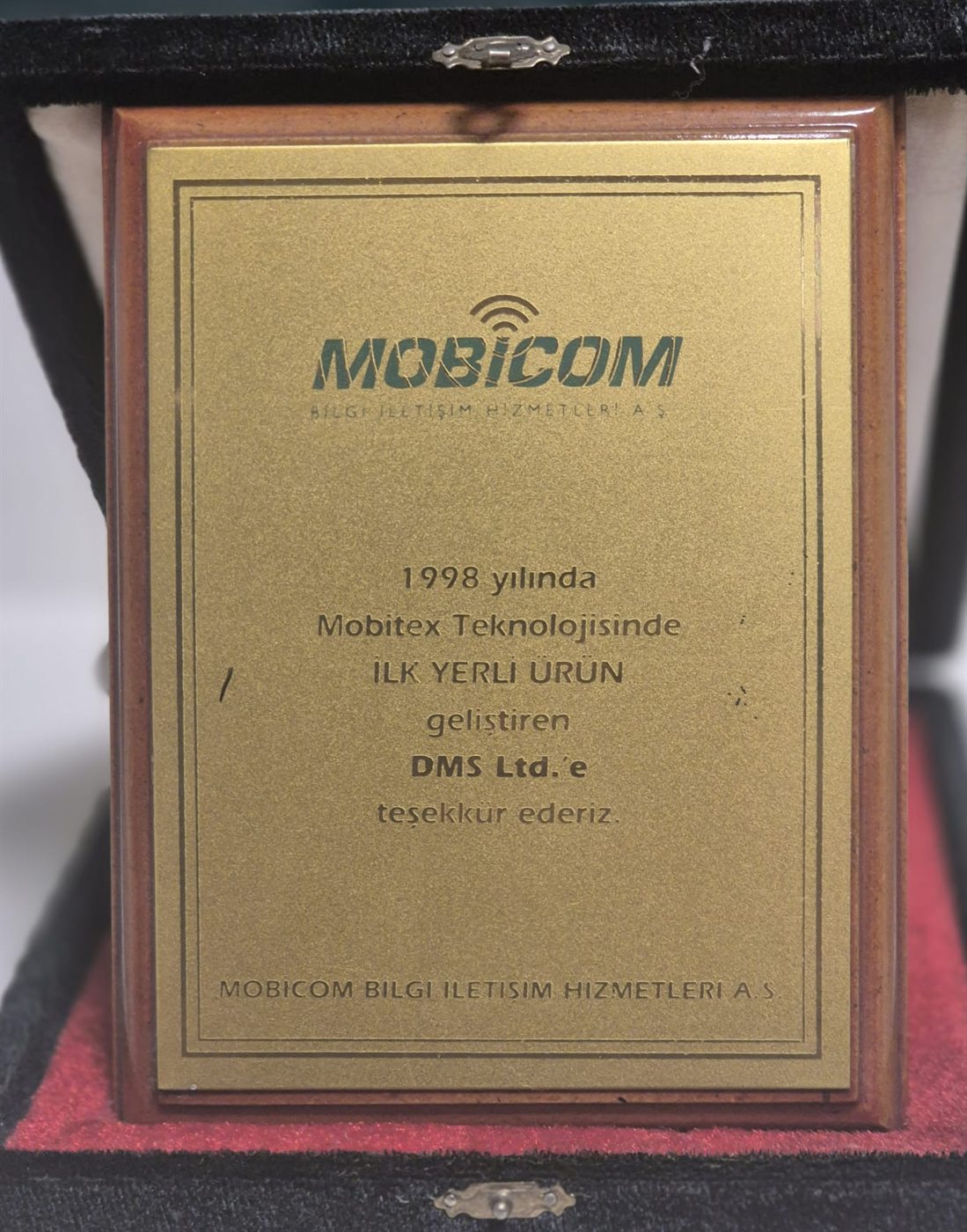
We built the first Turkish product running on Mobitex — wireless packet data, years before consumer mobile data existed. The network operator recorded it with a plaque.

Source: The operator's plaque — the physical object is ours; this copy was published on our own site in 2000 and archived independently the plaque as our site showed it in 2000
-
January 1999
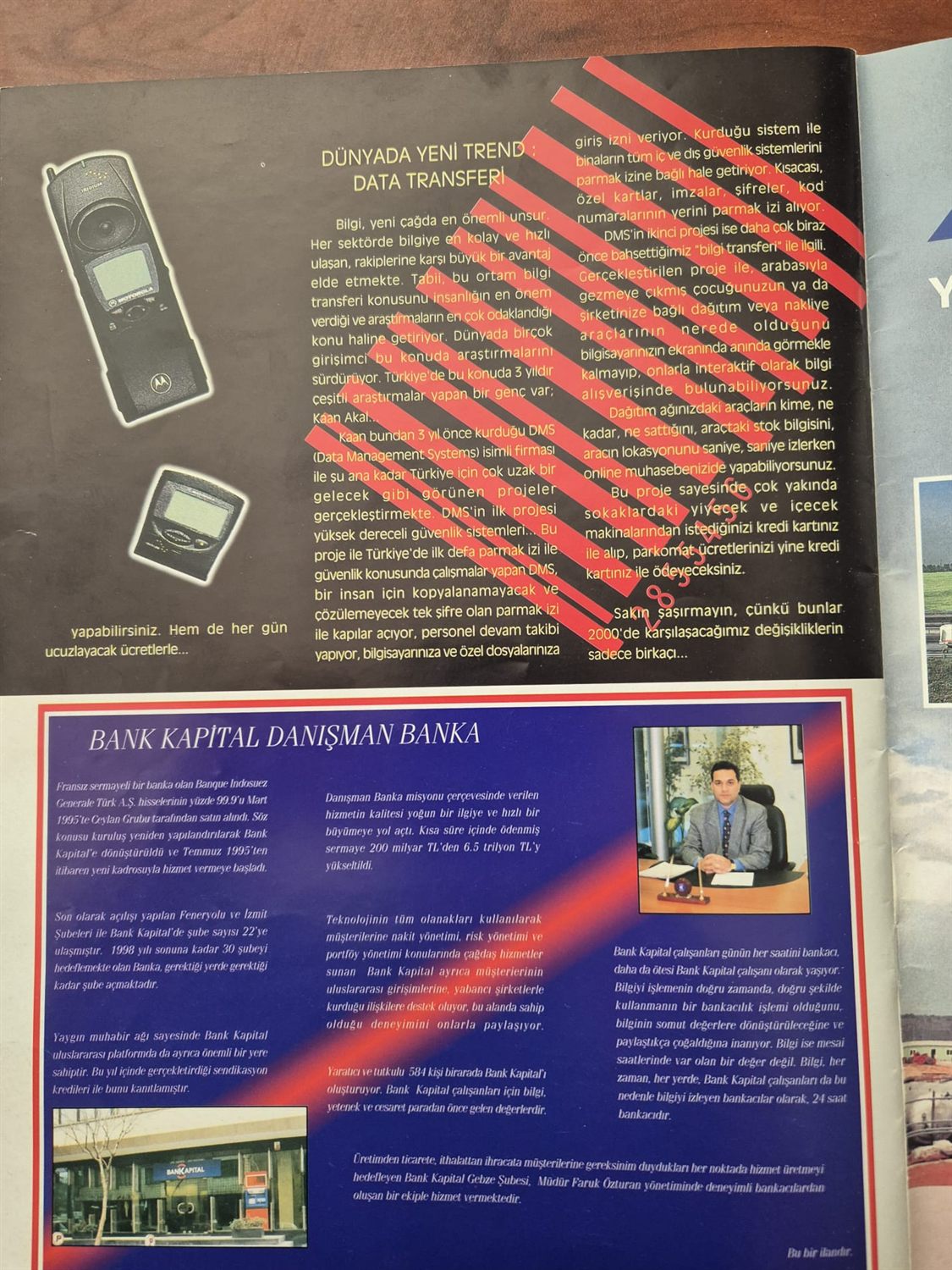
A forecast, in print
Describing our work to a chamber-of-commerce magazine, we listed three things: fingerprint security, collecting data from vehicles, and a vending machine that takes a credit card. None of the three existed in the field in Turkey at the time.

Source: Gebze Chamber of Commerce magazine, January 1999
-
1999
A credit card on a vending machine
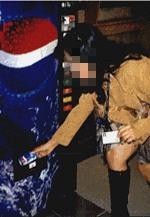
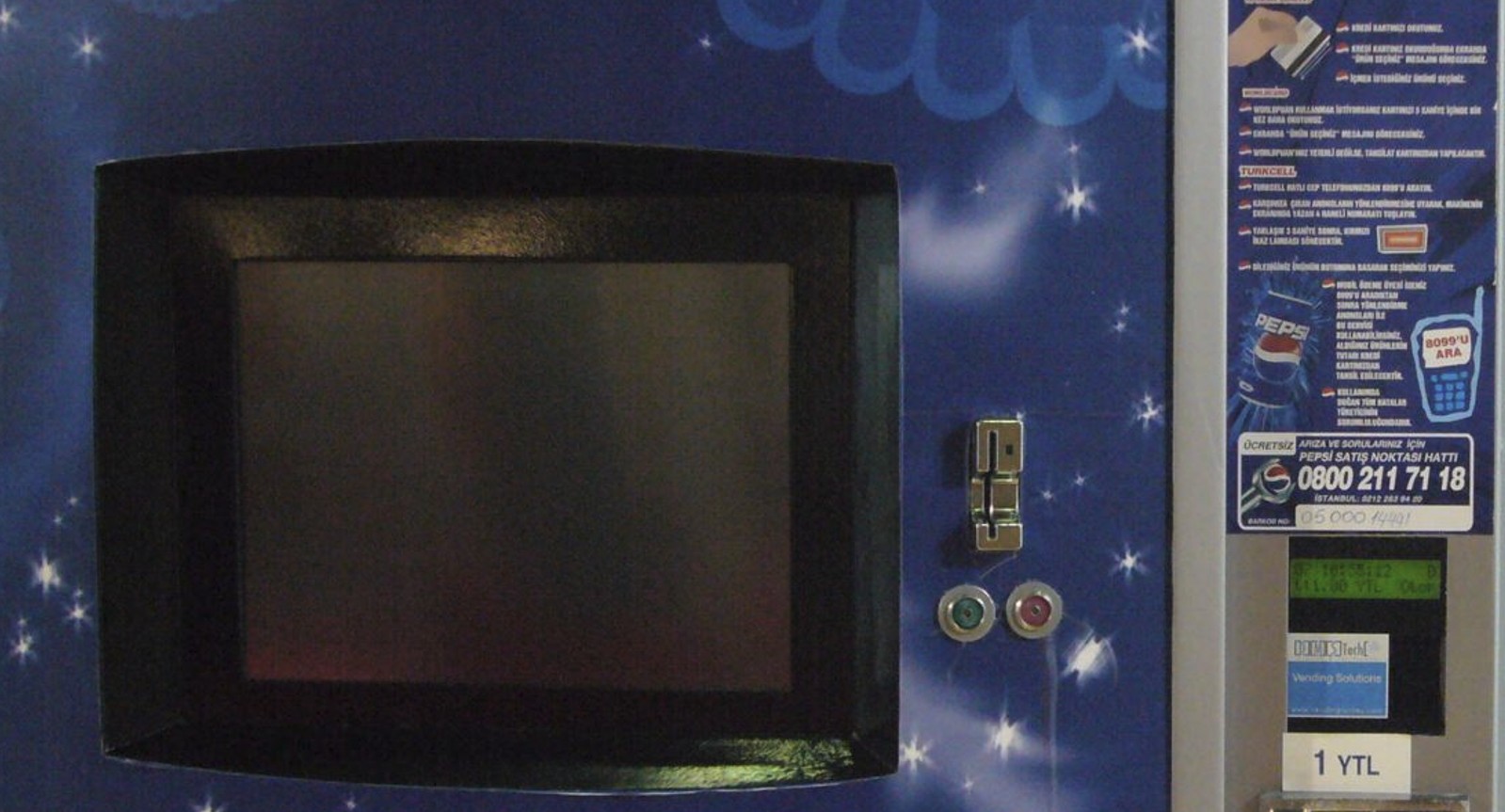
DMS Tech was incorporated. The same year we put a credit card reader on a Pepsi machine: the card is read at the machine, the transaction goes to the bank over a wireless network, the product drops. No cashier.
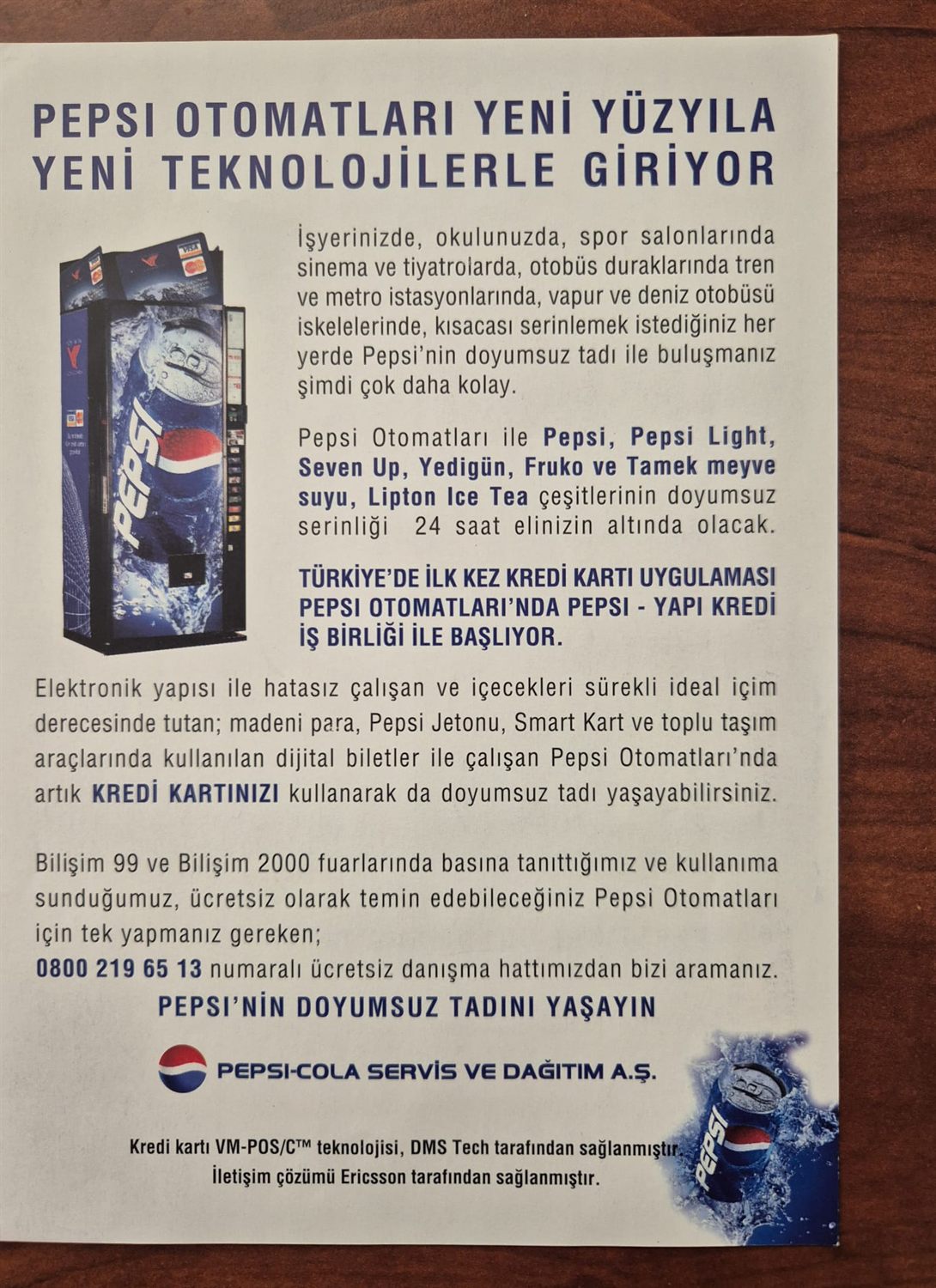
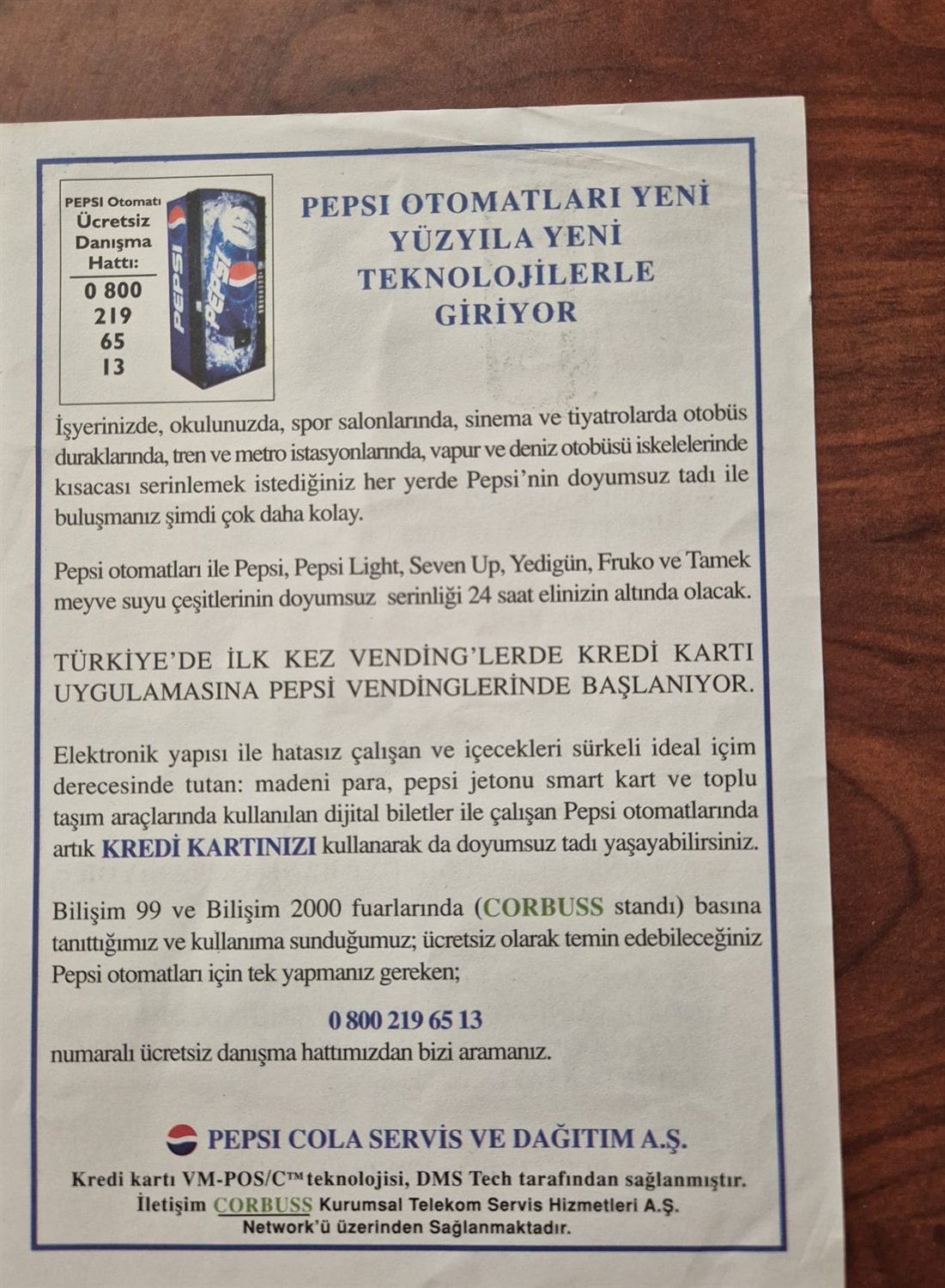
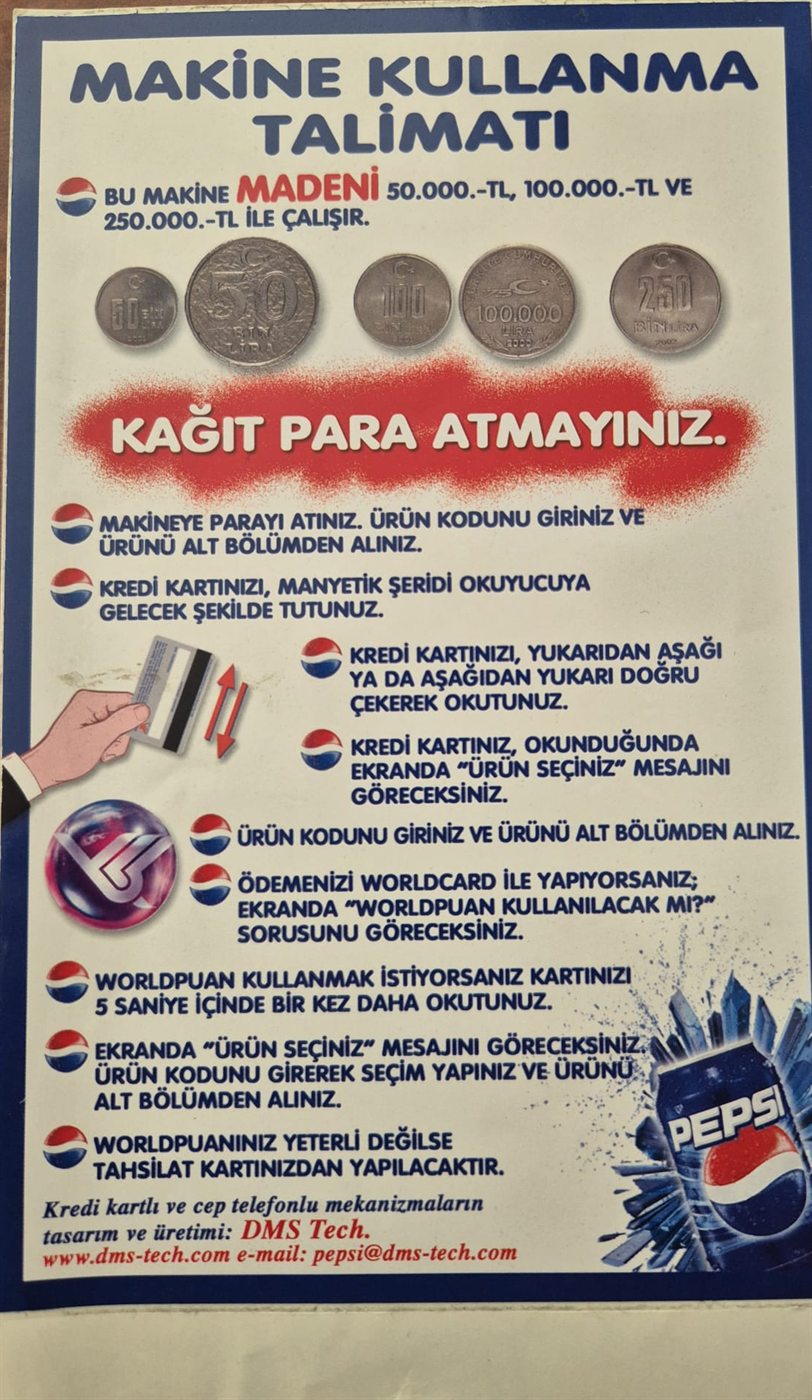
Pepsi's own launch leaflet announced it, and credited the technology by name: "Credit card VM-POS/C™ technology supplied by DMS Tech."


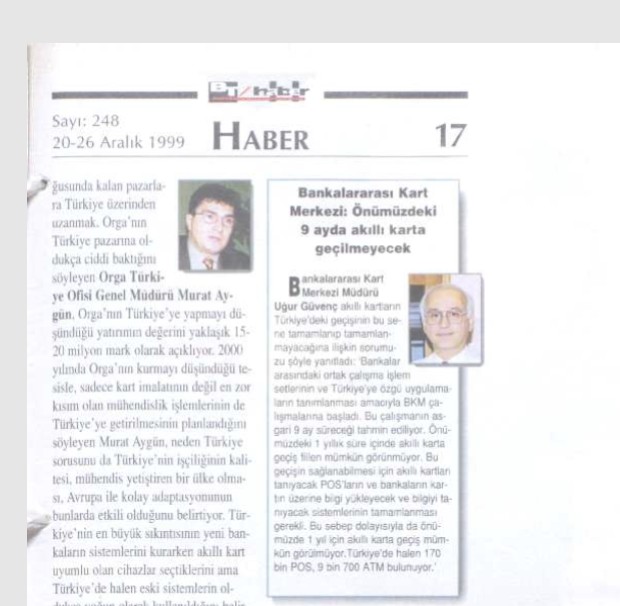
Source: Pepsi-Cola Servis ve Dağıtım A.Ş. launch leaflet · BT Haber (weekly IT trade paper), issue 248, 20–26 December 1999, p.17 BT Haber issue 248, in the paper's own archive
-
December 1999
At the fair: the card machine, and the phone
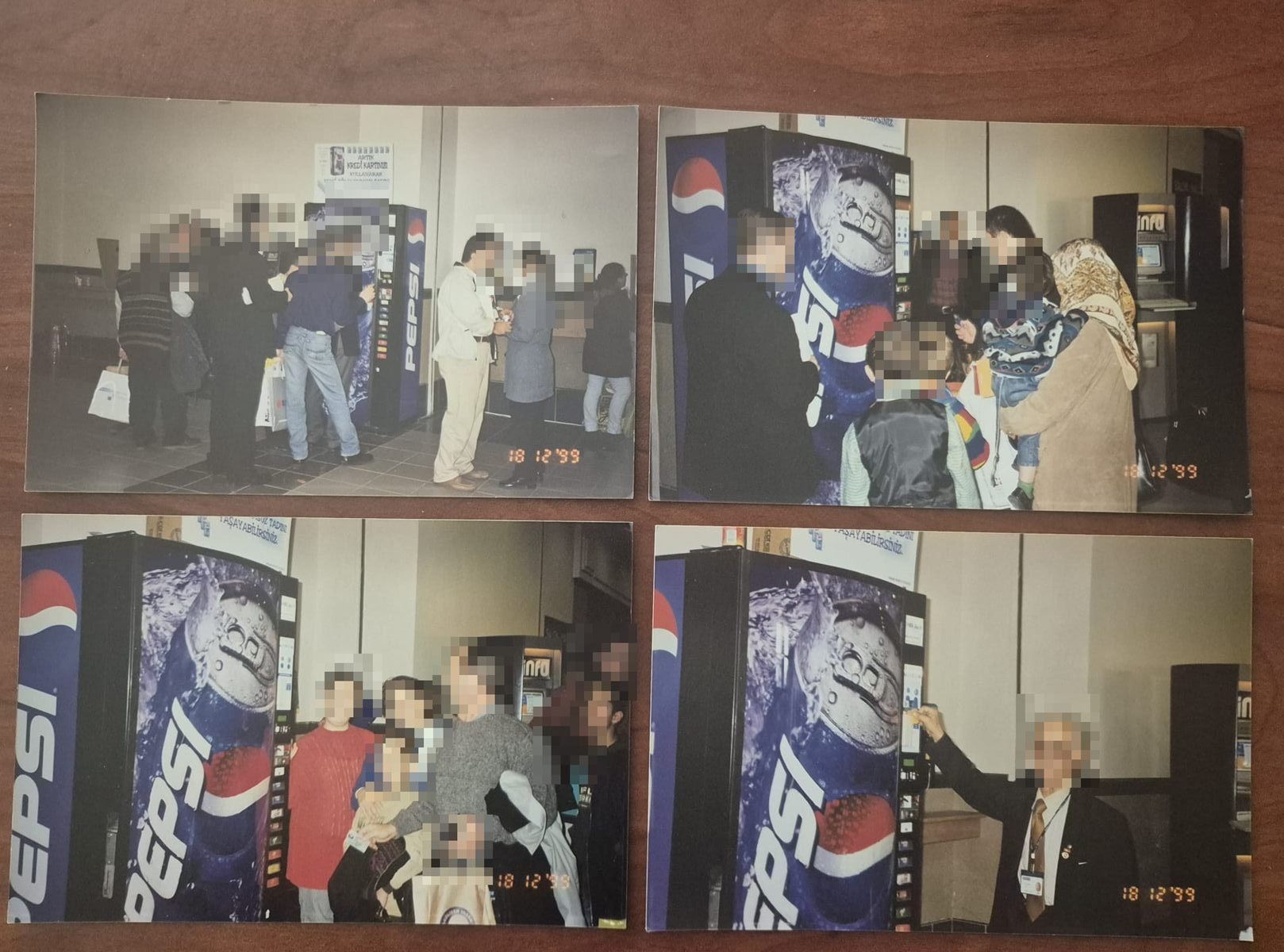
The card-paying machine was on the stand, with the line printed across it: "now, using your credit card…" Pepsi's own leaflet later described it as "presented to the press at the Bilişim 99 and Bilişim 2000 fairs, at the Corbuss stand." This is our work, photographed, at a fair of 113,000 visitors and 745 exhibiting companies.
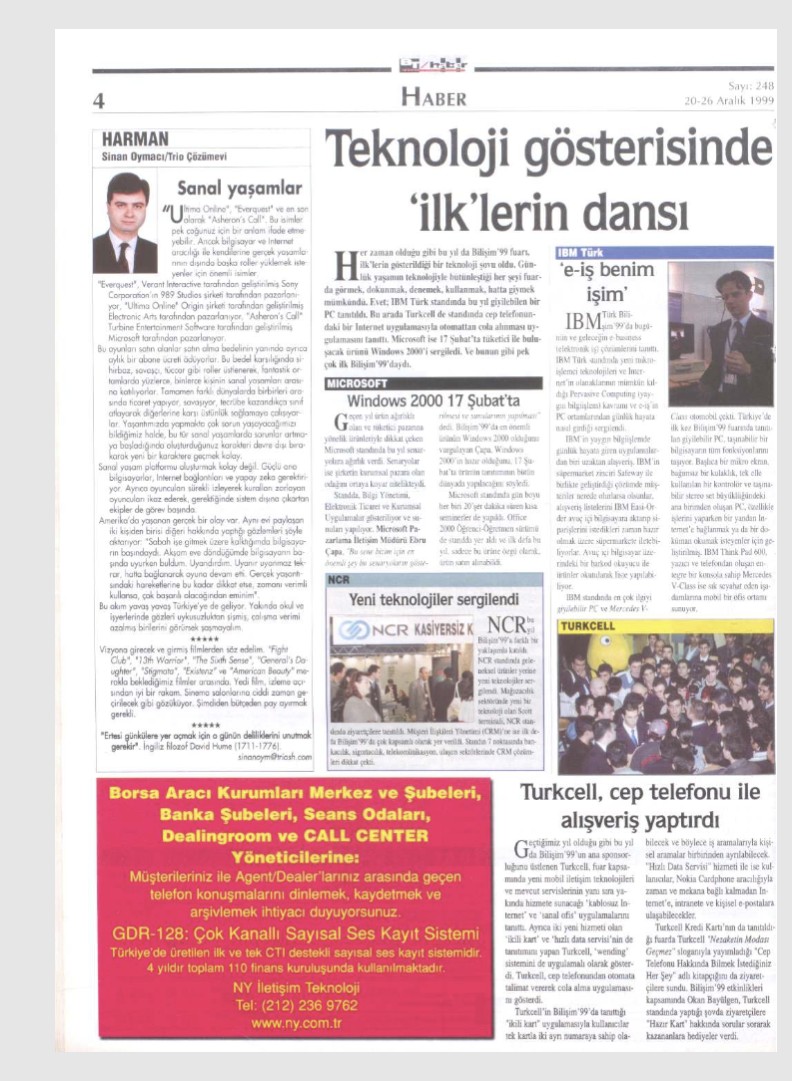
At the same fair, visitors also sent an instruction from a mobile phone to a machine and took a drink — the operator's own service, launched there. The trade press listed it among the fair's firsts, on the same page as IBM's wearable PC and Windows 2000.
And a reporter wrote it down on the spot. Hunting for coins at the fair entrance, he noticed he could pay by card instead; one of our founders showed him how, and a queue formed behind him. His piece, filed on 19 December 1999, is the earliest dated third-party account that names us: "the first credit-card drinks machine developed in Turkey … the product of a Turkish company, DMS Technologies", with the main board "designed entirely by DMS" reaching the bank over a modem and then taking control of the machine.


Source: BTnet, "Bilişim'99 Special", 19 December 1999, by Mahir B. Aşut · Pepsi-Cola Servis ve Dağıtım A.Ş. leaflet · operator press release (archived) · BT Haber, issue 248, 20–26 December 1999, p.4 · the fair organiser's own report the reporter's account, 19 December 1999 BT Haber issue 248, in the paper's own archive
-
1999 – 2001
One board, three applications
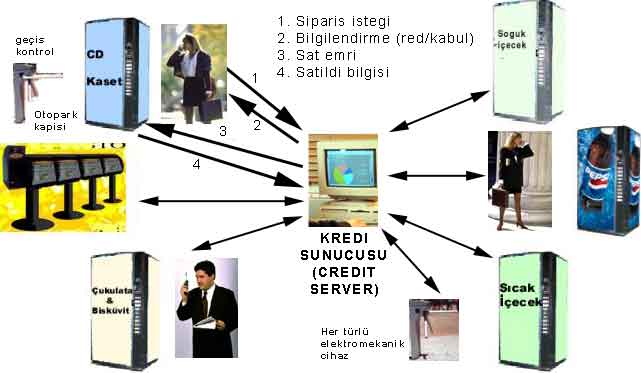
We built the product line on a single electronic board: telemetry, control of electromechanical machines that have no protocol at all, and card payment. The counterpart in the data centre was called Gateway 2000.

Source: Our ©2001 product brochures, archived the product brochure the Pepsi application note
-
March 2000
Out of the fair hall, into the street
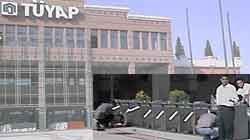
A fair stand is a controlled room. The real test was where the machines went next, and a national daily printed it: ten machines in Istanbul, at taxi ranks, universities and factories, running until April — over the Mobitex network.
Read the list of places again. Not one of them has a cashier. That was the whole point: the card wasn't the new part, the unattended place that accepted it was.
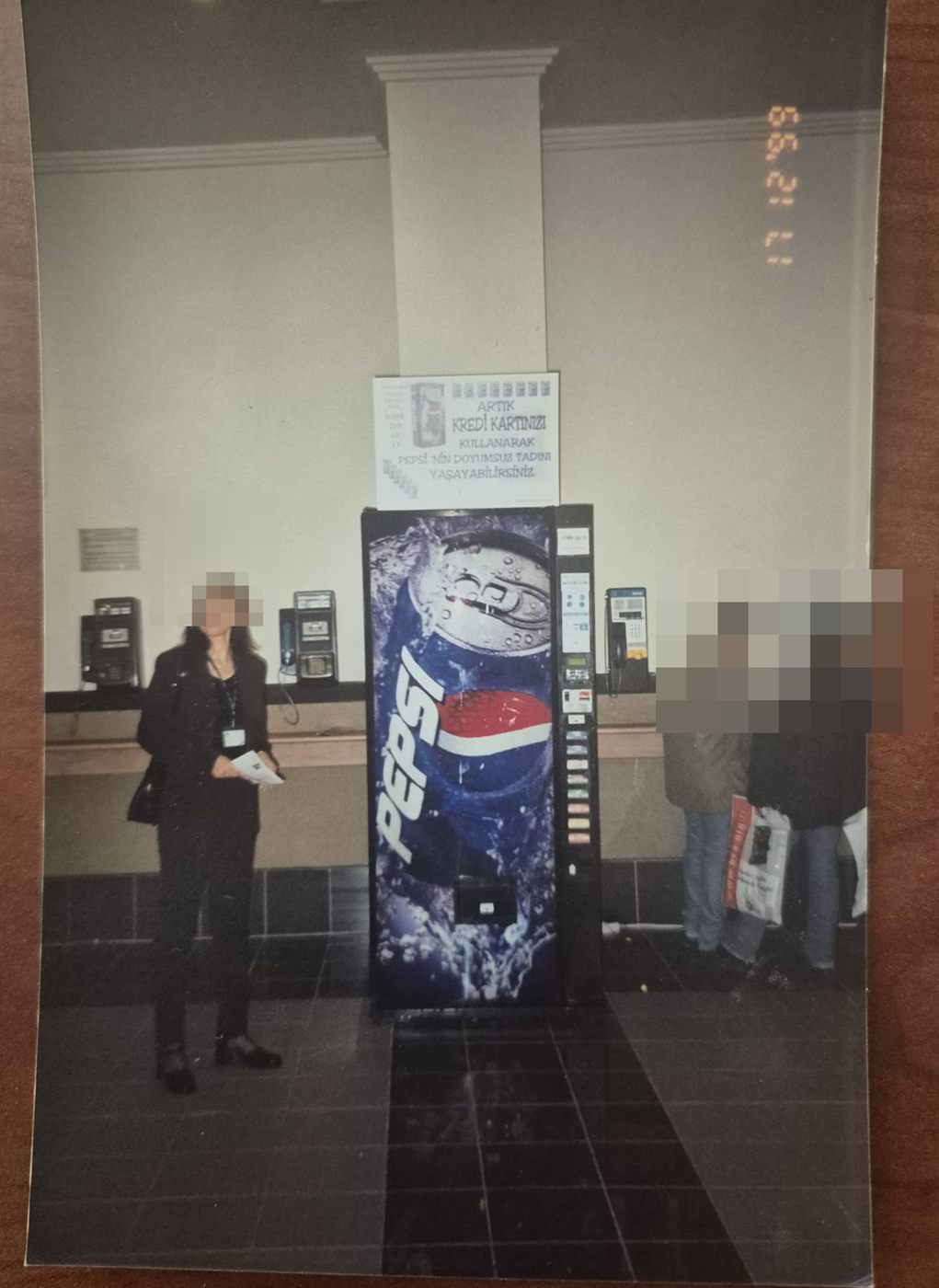
We have a photograph of one, standing in the snow at a taxi rank, with the camera's own date stamp in the corner: 27 January 2000 — two months before the article was printed.


Source: Radikal, 19 March 2000, "Ordering a Pepsi from your mobile", by Hale Tüzün. As usual for the period, the piece speaks through the brands and does not name the supplier — the machines and the payment layer in it are ours the newspaper report
-
September 2000
The phone became the ticket in
At a fair of roughly 150,000 visitors, part of the entrance turnstiles opened by mobile phone. A visitor dialled the turnstile's number and the gate opened; those with a withheld number did the same thing by SMS. The system worked on the identity of the calling number.
What mattered as much as the mechanism was the record behind it: every passage was collected in a central data management system. That is where the company's name comes from — Data Management Systems.

Source: dms-tech.com, 2002 (archived) · our own newsletter, ~September 2000 · BT Haber, issue 285, 11–17 September 2000 · DonanımHaber, 10 September 2000 the DonanımHaber account our own write-up, 2002 our newsletter, 2000
-
September 2000
A drink out of a machine, by text message
At Bilişim 99 the operator had announced that buying from a vending machine by SMS would enter service "during 2000". It did. At the next fair the machine stood on the operator's own stand: text TB and it gave you the operator's mascot, text PC and it gave you a Pepsi.
We built the machine-side of it — the control card that listens for the message and releases the product. The wish came from the customer, in their own words: encourage people to use mobile commerce, by letting them buy something with it.

Source: Our own newsletter, ~September 2000 (archived) · the operator's own Bilişim 99 press release, which announces the service but names no supplier our newsletter the operator's 1999 announcement
-
September 2000
Online card payment at the machine, on the fair stand
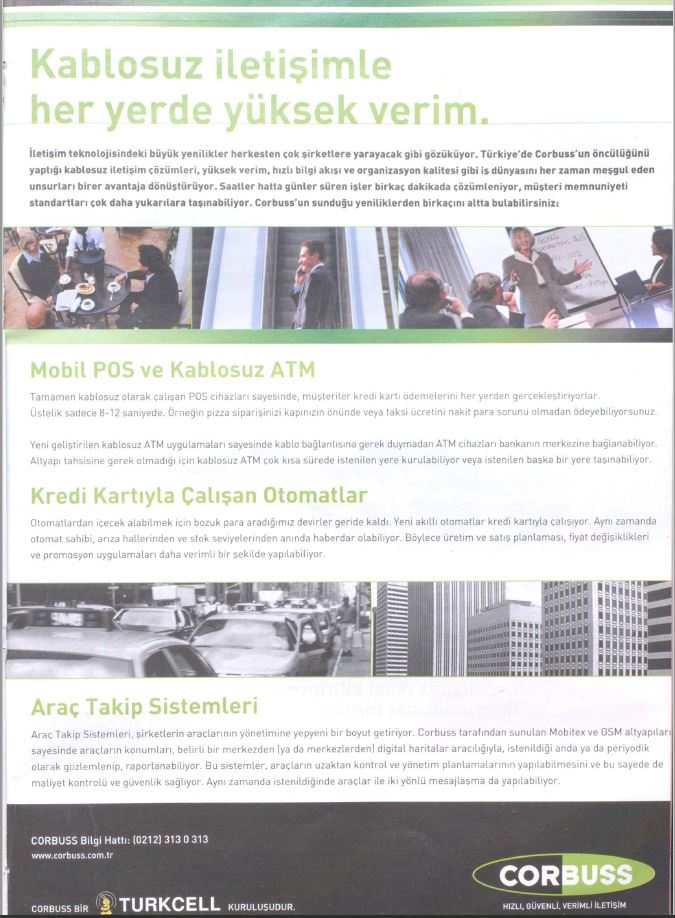
The machine was at the same fair. Pepsi's leaflet says it was "presented to the press at the Corbuss stand at the Bilişim 99 and Bilişim 2000 fairs." A visitor walking that stand wrote up the services on offer that week, and listed "credit-card vending service" among them.
The clearest statement of what this was comes from the customer. Pepsi's own promotional leaflet says, in capitals: "FOR THE FIRST TIME IN TURKEY, CREDIT CARD PAYMENT IS STARTING IN VENDING — AT PEPSI VENDING MACHINES." The other print of the same leaflet ties it to the Yapı Kredi partnership. And on the same paper it is written whose application that was: "Credit card VM-POS/C™ technology supplied by DMS Tech." So "first in Turkey" is not our sentence — it is the customer's, and we are simply the party named on the same page.
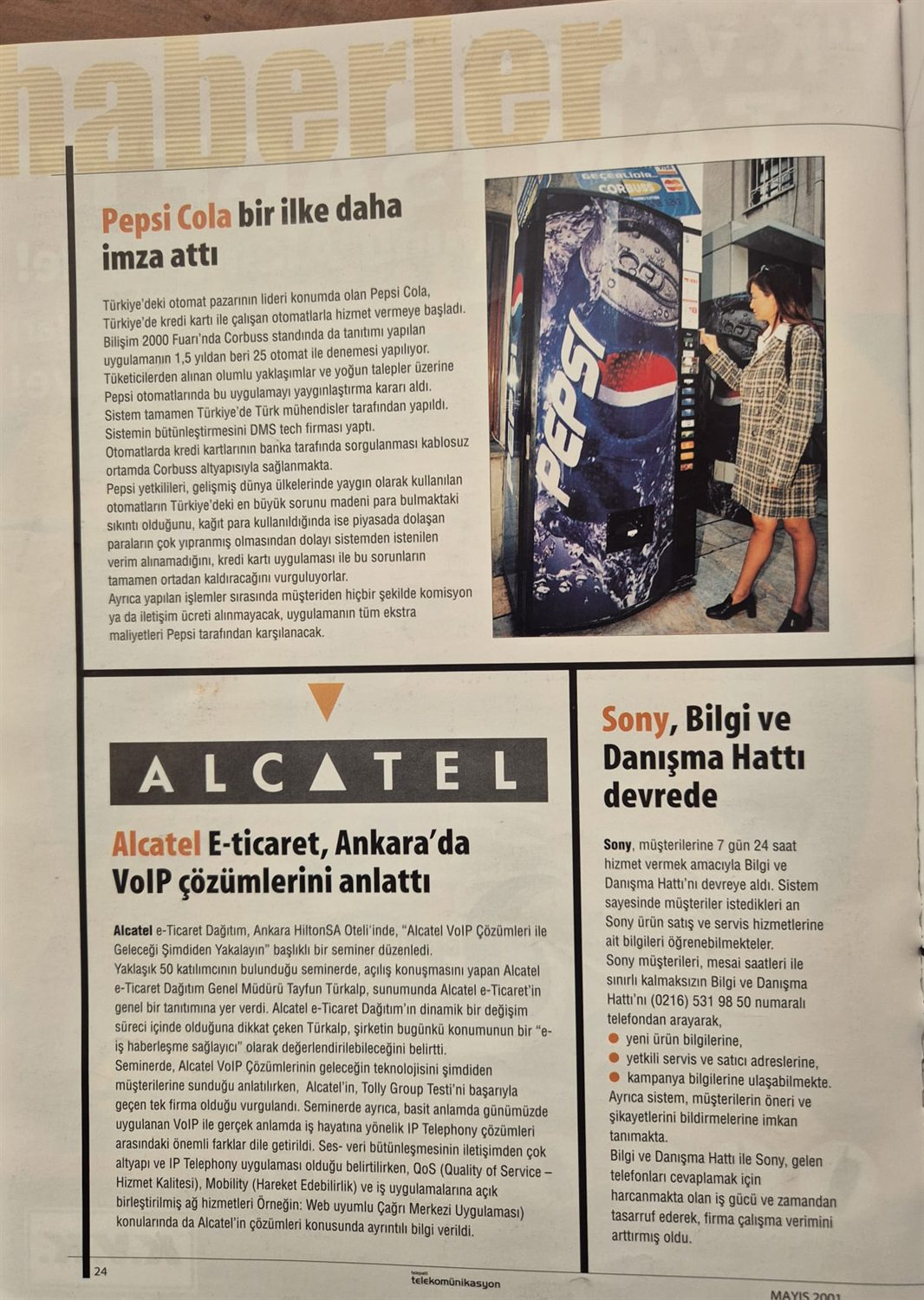
A trade magazine confirms the same stand independently: writing the following year, Telepati describes the application as "also shown at the Corbuss stand at the Bilişim 2000 fair," and adds that it had by then been trialled on 25 machines for a year and a half. Three accounts, one stand — a customer's leaflet, a visitor's write-up, a magazine.


Source: Pepsi-Cola Servis ve Dağıtım A.Ş. leaflet · DonanımHaber, 9 September 2000 · Telepati, June 2001 DonanımHaber, 9 Sept 2000
-
2000 – 2001
Machines go into the metro
The machines were installed in metro stations. The launch leaflet printed for that rollout lists what they accept: coins, tokens, a smart card, transit tickets used on public transport, and a credit card.
Placement and payment method were two halves of one decision: a machine in a metro station has to take the transit ticket.
Source: Pepsi-Cola Servis ve Dağıtım A.Ş. leaflet · JR East
-
2001
From trial to rollout
After eighteen months and a 25-machine trial, a service contract was signed. Wireless — no telephone line was ever run to a machine.
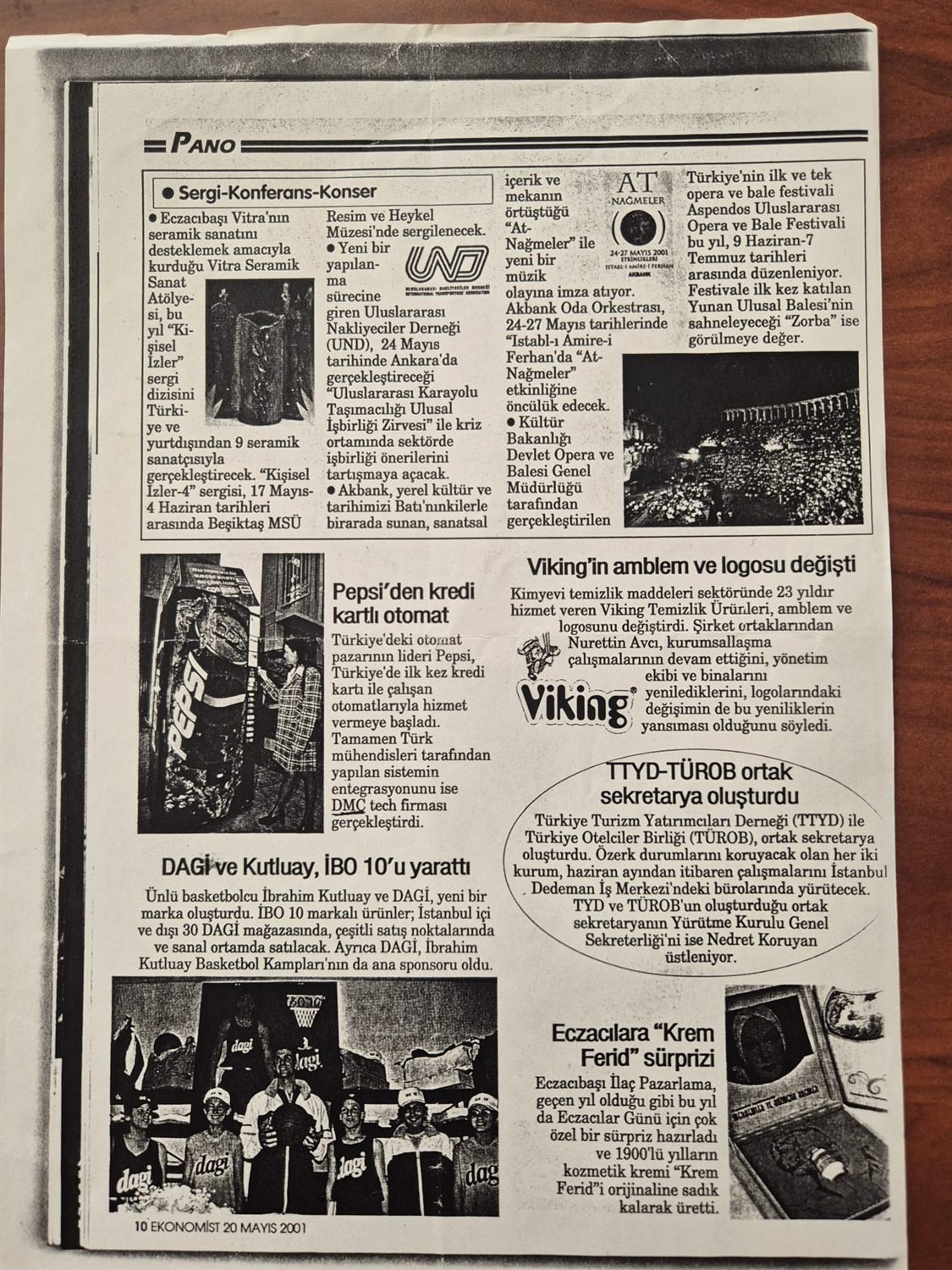
This is the year the press picked it up, and two magazines named us: the weekly Telepati wrote that "the system integration was done by DMS tech," and the business magazine Ekonomist ran the same launch weeks earlier — illustrated with a photograph that also sits on our own website, archived.
That August a television news site covered another Pepsi machine — one you bought from by phone. At launch it played a jingle when you called the short code, and then the machine dispensed. The report credited the communications supplier for the jingle side and said nothing about the machine side; Pepsi's own leaflet prints that division in full — card technology to DMS Tech, communications to the partner.
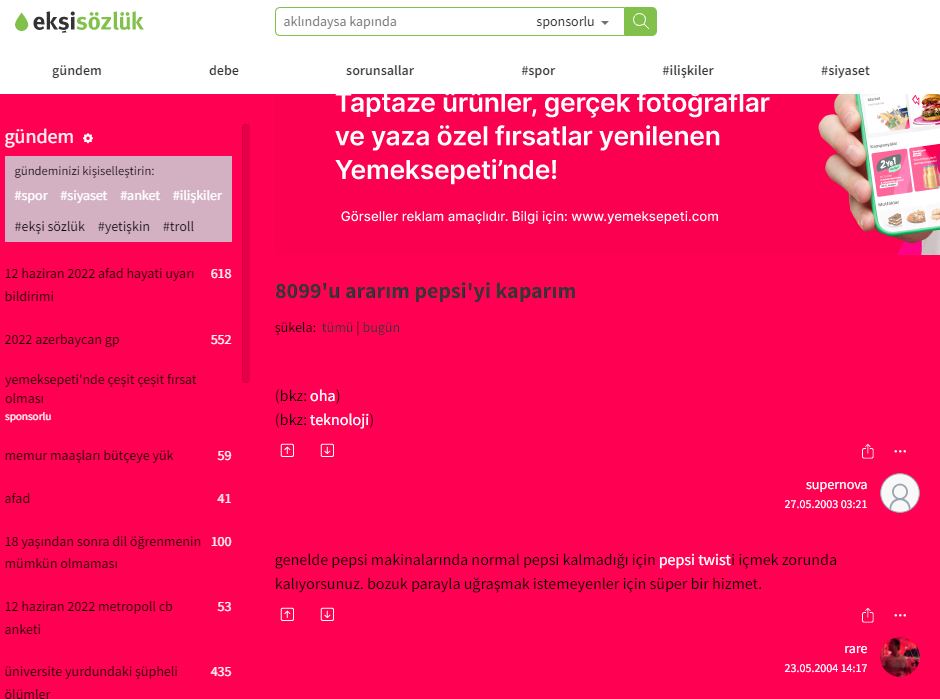
The jingle was dropped soon after. What stayed was the part underneath: you called, you got the product, and the price went onto your mobile account. That service ran for years — the short code was 8099.


Source: Telepati, June 2001, archived — names us · Ekonomist, 20 May 2001, p.10 · NTV-MSNBC, 19 August 2001 (credits the communications supplier, not the machine side) the Telepati article
-
2002
"Connect the machine you already have"
Our own website listed what we did: existing vending machines, taximeters, parking meters, turnstiles, doors, fuel pumps. And the phrase we used to describe ourselves: protocol converters, gateways.

Source: dms-tech.com, 2002, archived our 2002 site
-
2003
A drink billed to a phone account
The service that started in 2001 was now simply part of the field. Users called 8099, took a product from the machine, and the cost appeared on their phone bill. User comments from those years are still online: "great service for anyone who doesn't want to deal with coins."
The same year we put the third generation of the payment unit into series production.


Source: Two national dailies on the same day — Hürriyet and Yeni Şafak, 12 August 2003 · dated user forum posts, 2003–2004 · a later field photograph of the same service the Hürriyet report the Yeni Şafak report the forum thread, from 2003
-
2005
The cloud, before the word
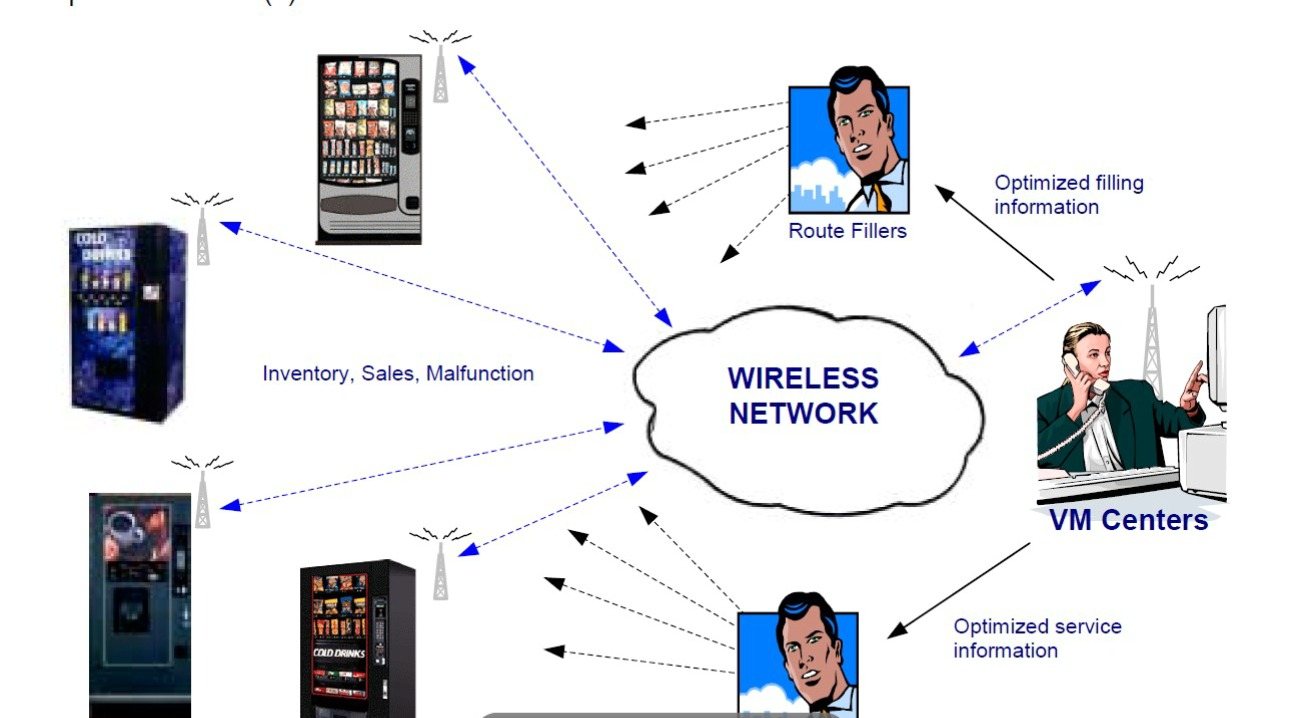
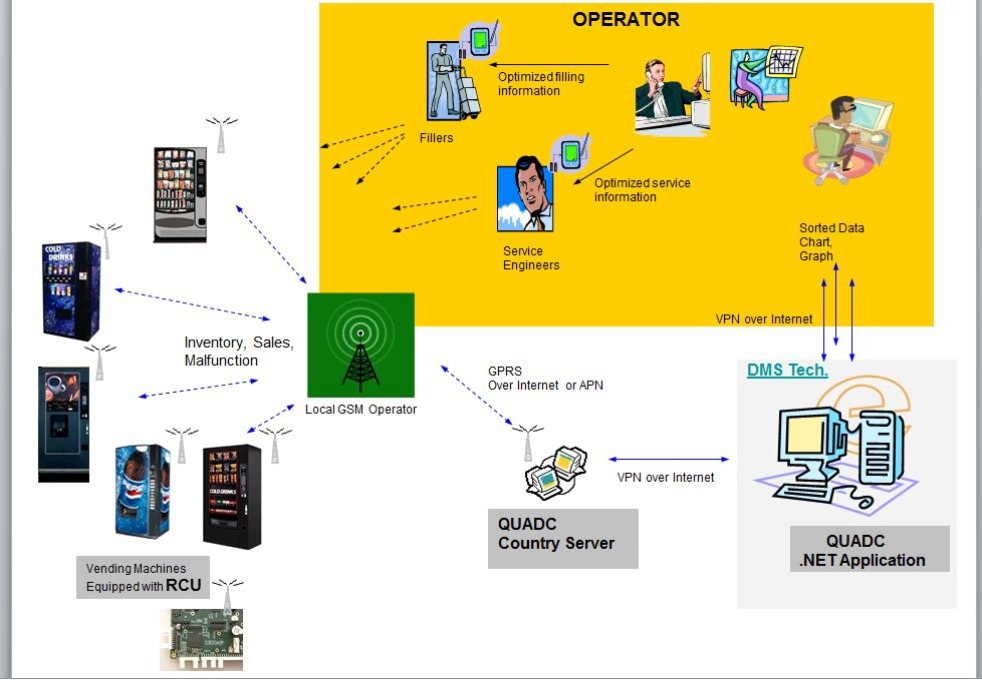
We named the central system: country server, VPN, reporting. What is now called a telemetry platform.

Source: Our own archive — the 2005 architecture drawing
-
December 2007
The one we lost
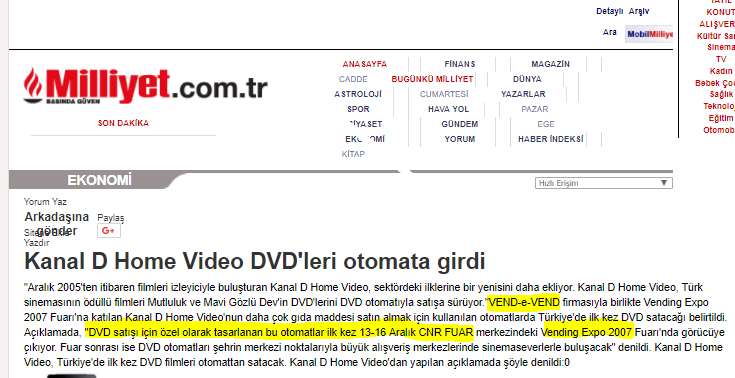
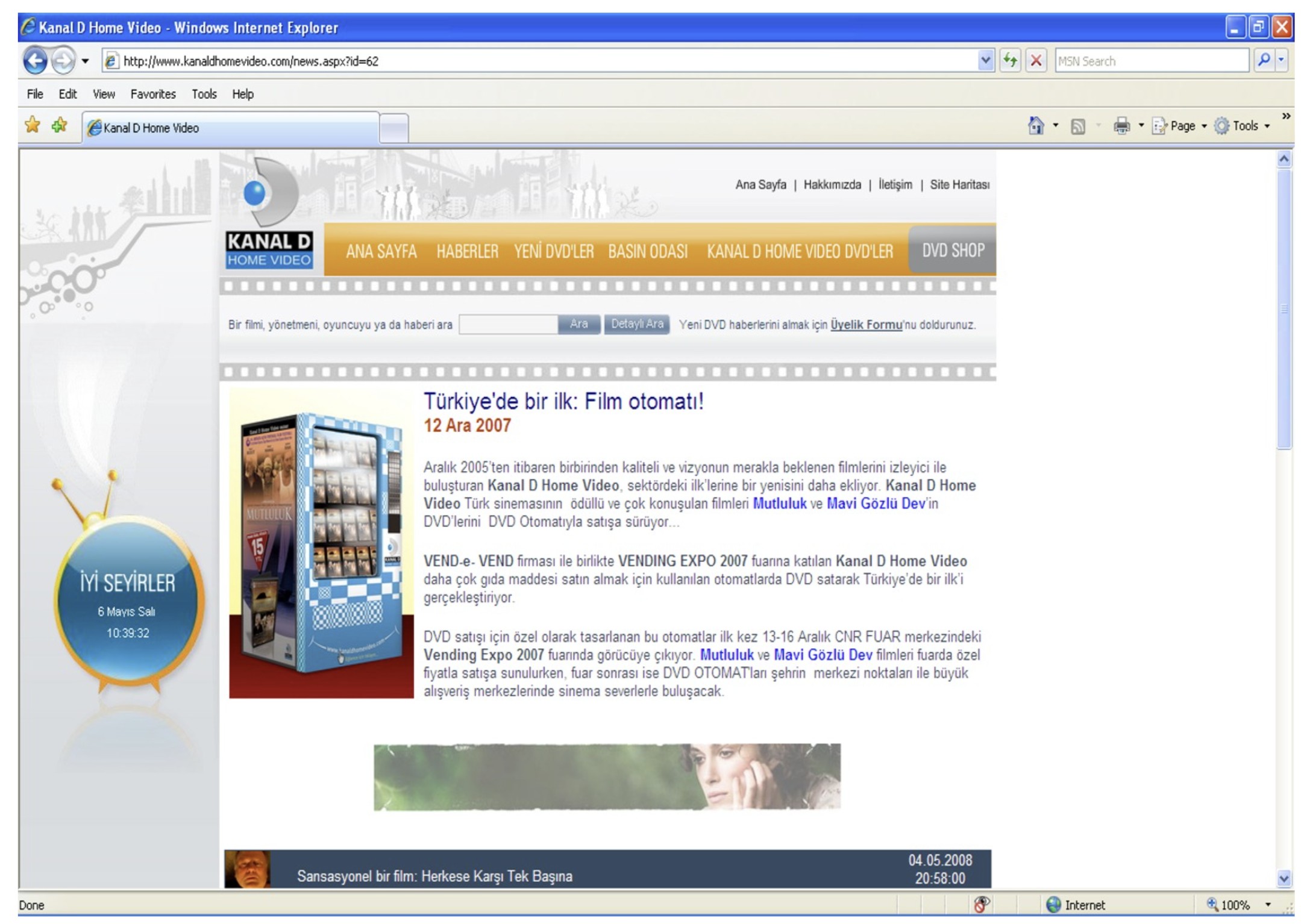
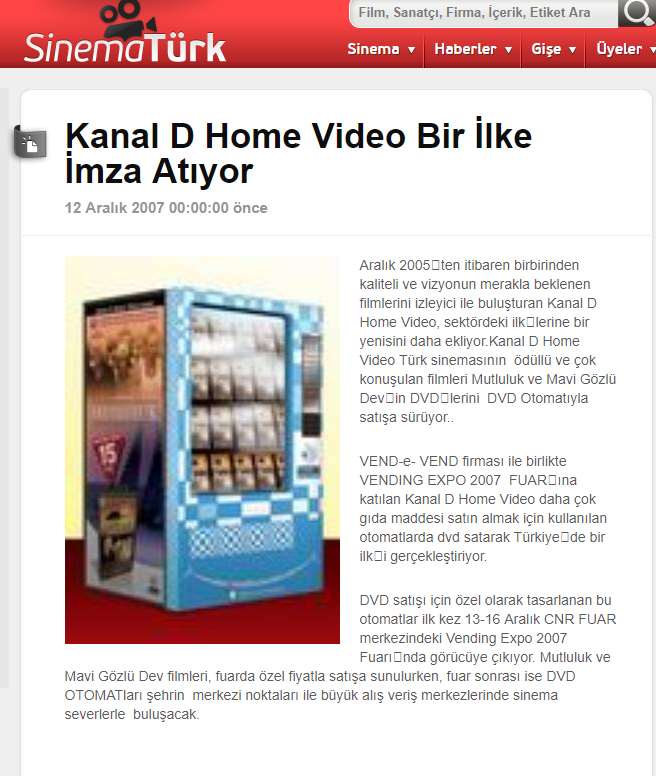
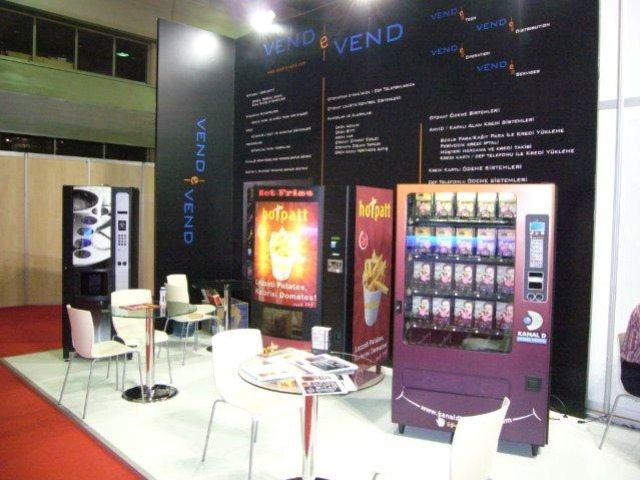
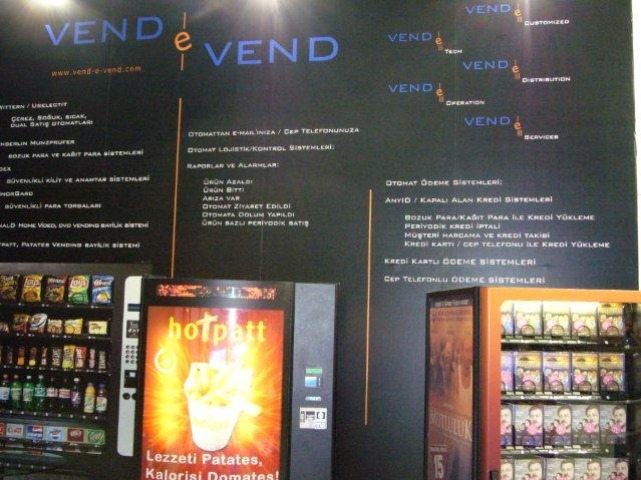
Around two thousand machines were being monitored online. On our own stand that year the range on show was telemetry, payment and product variety at once — including a DVD rental machine for Kanal D Home Video, and a chipped-potato machine.
The DVD machine reached the press, and — unusually for us — it was named: in one week two publications and the customer's own website all credited the machines to VEND-e-VEND. Kanal D Home Video put it on their own news page under the headline "A first in Turkey: the film machine!", and inside the story they put both halves in one sentence: "Kanal D Home Video, taking part in VENDING EXPO 2007 together with the VEND-e-VEND company, is achieving a first in Turkey by selling DVDs from machines." The claim and the name beside it are both in the customer's own hand — we quote it as theirs.
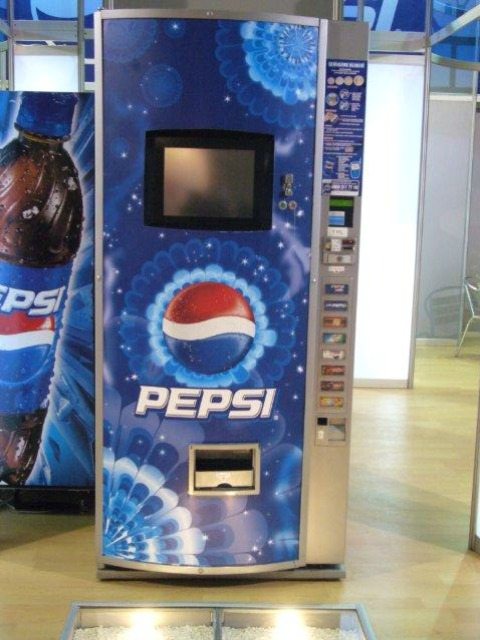
Another machine on the same stand carried a transit card. We put a touchscreen into the middle of a Pepsi machine and ran Akbil top-up on it — and the top-up was paid by credit card, so loading a transit card went through the bank-card flow already running on that machine. The screen was not just a top-up form either: the point was to turn the machine into an interactive city experience. At the fair it was not sitting in a display case; it was demonstrated working. Akbil is the ancestor of the Istanbulkart — this is the first link in a chain that reaches the Istanbulkart twelve years later.
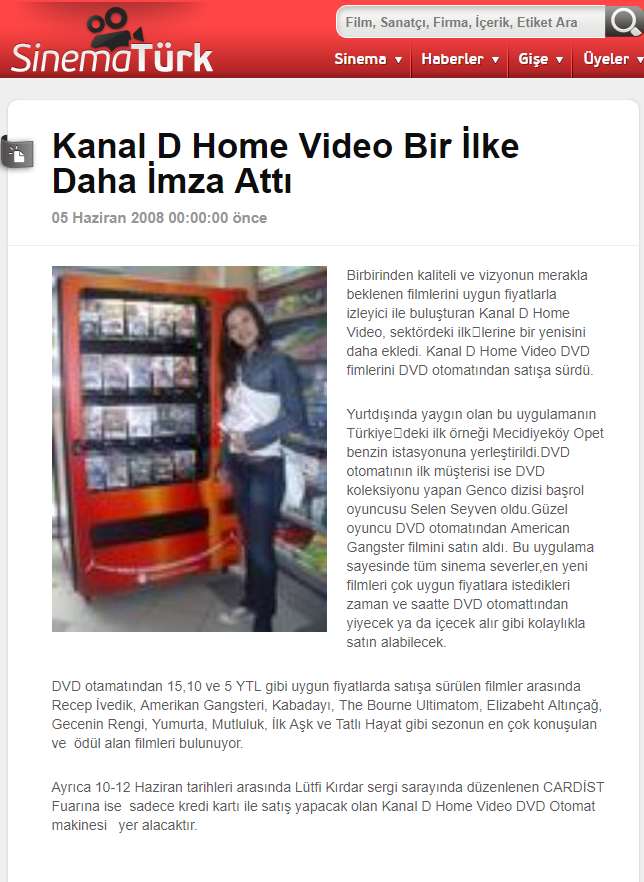
It went into service, too: one was installed at the Opet petrol station in Mecidiyeköy, Istanbul. And it was still news six months later — in June 2008 the same machine, selling by credit card only, went to the Cardist card-industry fair at Lütfi Kırdar. So this was not a one-off launch announcement.
It also turned out to be a dead end: the product it sold was on its way out.


Source: Kanal D Home Video's own news page, 12 December 2007 · Milliyet, 13 December 2007 · SinemaTürk, 12 December 2007 and 5 June 2008 · our own stand catalogue the Milliyet article
-
2008
Contactless
Moving to a new acquiring bank, we put the first contactless product in front of our controller into the field. The reader was OTI's; we wrote the serial protocol between that reader and our board, and OTI added it to their own reader firmware. The link carrying encrypted data to the centre and on to the bank was ours.
This line stayed in production for seventeen years, until 2025.
One capability moved with the bank. Yapı Kredi cardholders could already spend Worldpoints at the machine — read the card again within five seconds and the points paid, with any shortfall taken from the card. When the acquiring moved to Garanti, we rebuilt the same flow for Bonus points. Loyalty redemption at an unattended machine, twice, on two different schemes.
That June, our card-only machine stood on the Ingenico, Garanti and Akbank stands at the Cardist fair — running a different protocol, unrelated to the first. We were not an exhibitor; the machine was on their stands, which is the whole pattern of this page in one sentence.
Source: OTI (On Track Innovations) corporate site, archived · Garanti BBVA · the Cardist dates and the card-only machine are documented in SinemaTürk, 5 June 2008 OTI's archived page
-
2008 – 2010
We replaced the whole fleet
Every payment unit in the field was replaced with the new controller and a contactless reader, in a migration spread over two years.
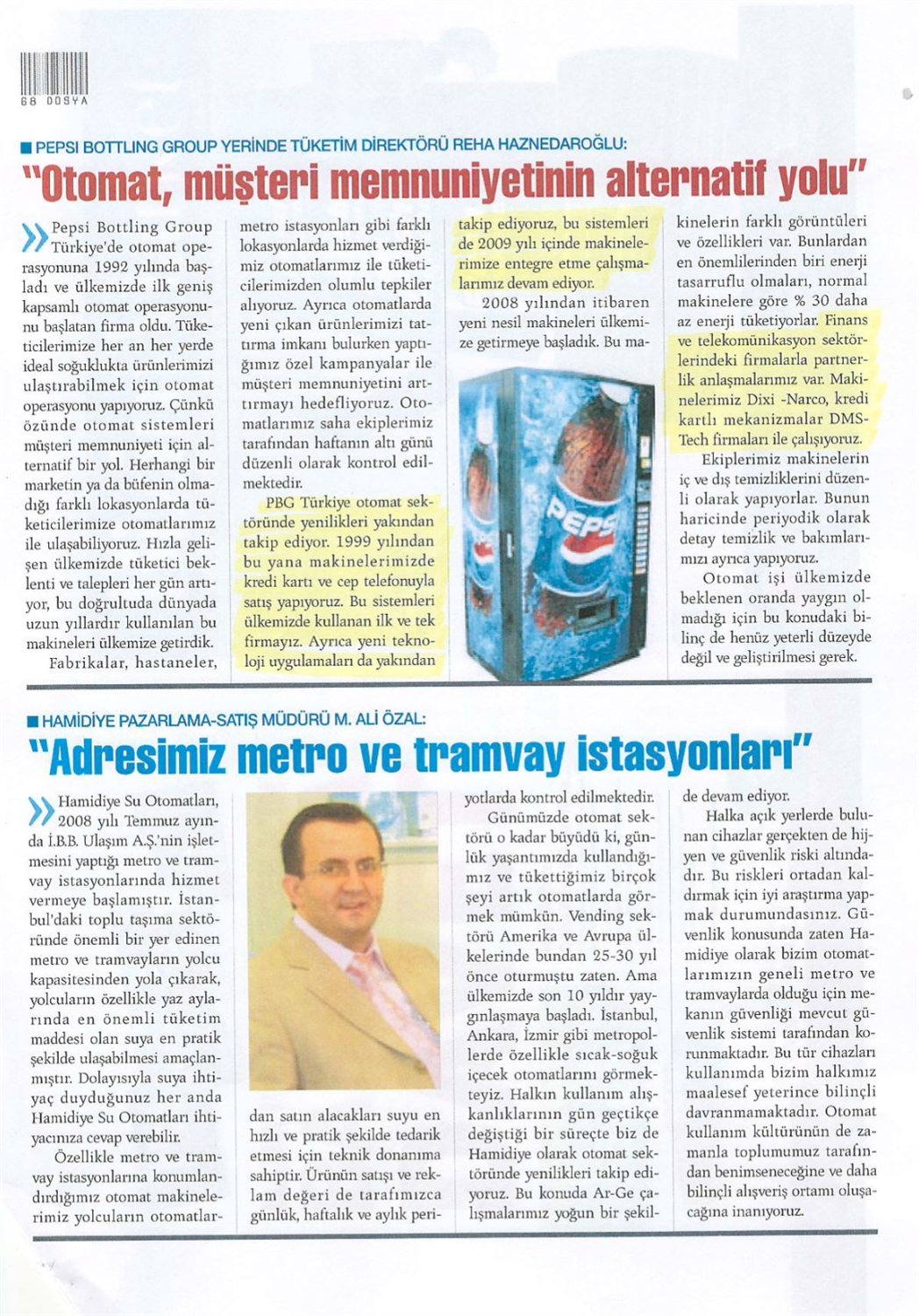
Mid-migration, a trade magazine put it on the record: interviewed in August 2009, the bottling company's own director credited the card-payment mechanisms to DMS Tech, by name.

Source: Bizim Market, August 2009 — the bottler's own director naming DMS Tech · our own archive
-
2009
On the standard's list
We had registered our manufacturer code in the vending industry's data transfer standard (EVA DTS) in May 2008. The July 2009 edition is the earliest published list held in public archives — and on it are three companies from Turkey, ourselves among them.
Source: EVA DTS manufacturer code registry, July 2009 edition · registration date from our own records the July 2009 list
-
2010
CSC / AnyID goes live — and a campaign is won
The closed-loop system went live under its own name: CSC / AnyID. Three things at once — closed-loop credit, loyalty, and entitlement. Staff buy from the machine with the badge they already carry to work, against an allowance their employer defines. AnyID is the point: the credential can be a magnetic card, a smart card, an access badge — whatever the site already uses.
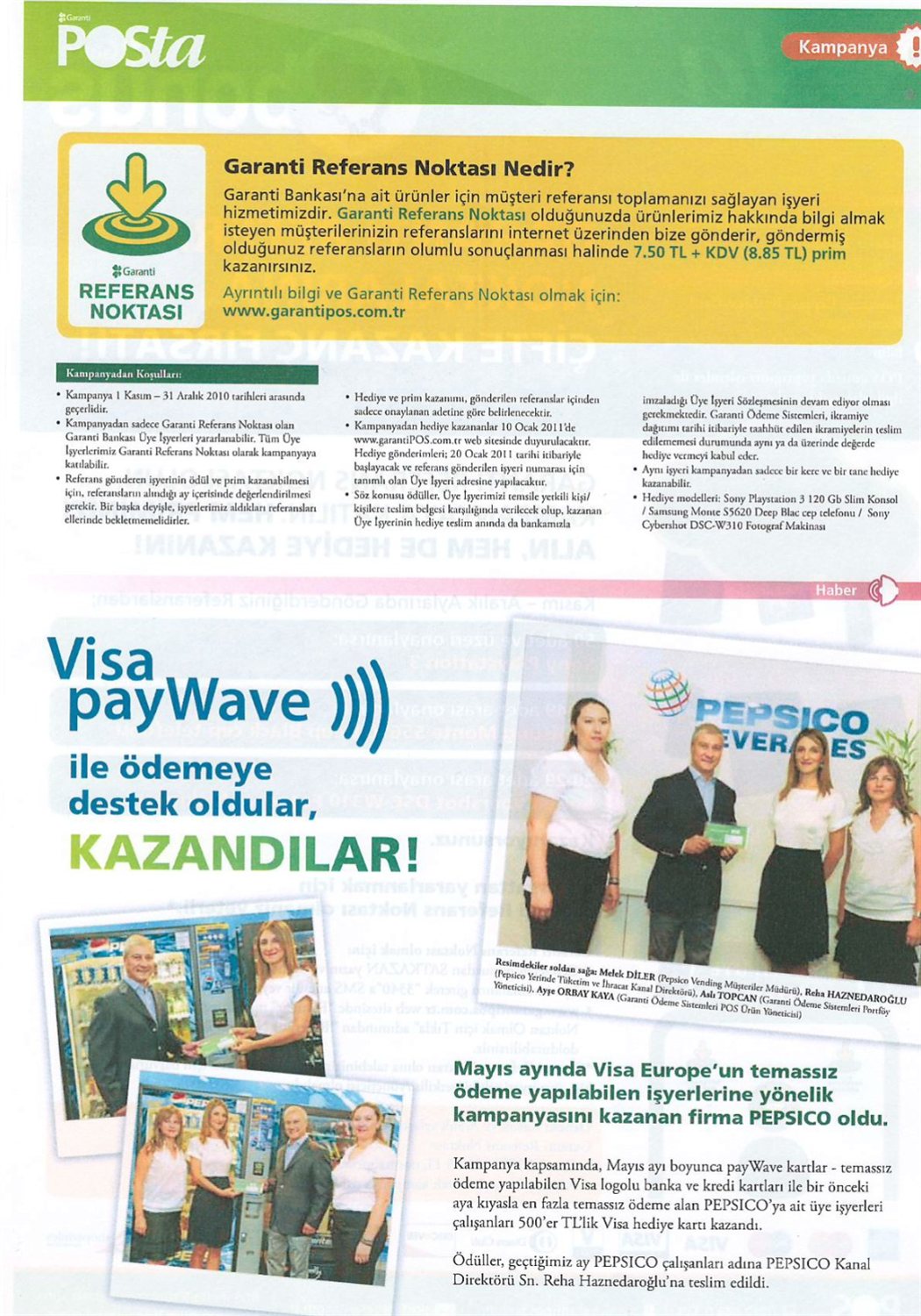
The same year, Visa Europe ran a May campaign for merchants accepting contactless, and PepsiCo won it: their sites took the largest month-on-month increase in contactless payments in the country. The contactless terminals on those machines were ours.

Source: Garanti POSta
-
2011
NFC in the field
NFC was running on the machines.
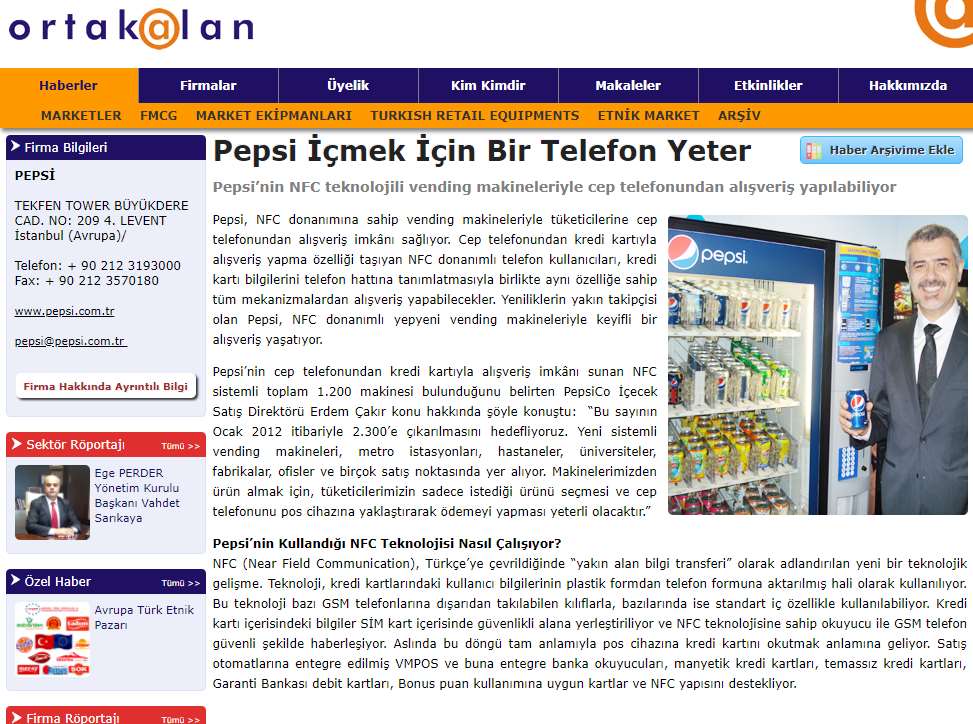
The launch coverage did something the rest of this page rarely gets: it named the product. The reports describe the machines as carrying VMPOS — our unit — and list what it accepts: magnetic stripe, contactless, the bank's debit cards, cards eligible for spending loyalty points, and NFC. That list is the 2008 work still running three years on, loyalty redemption included. The company name is absent; the product name is not.
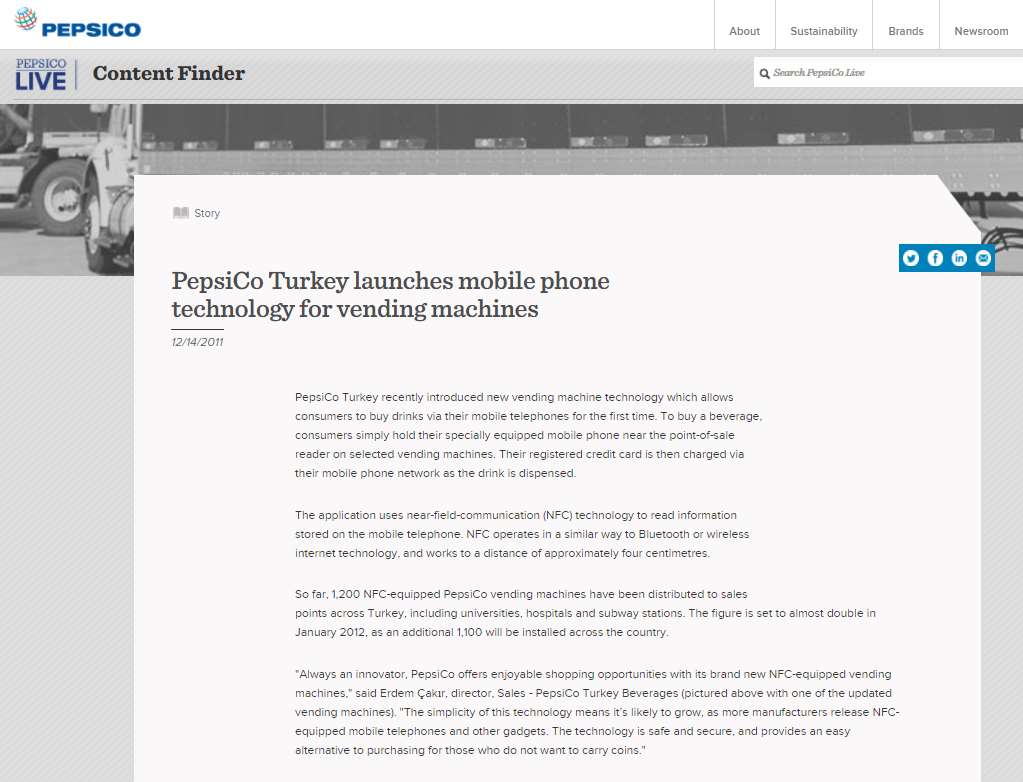
PepsiCo announced it on their own global site that December, with the scale attached: 1,200 NFC-equipped machines already placed across Turkey — universities, hospitals, subway stations — and another 1,100 due in January. That page has since gone from the web entirely; the screenshot below is the only copy we have of it.


Source: sondakika.com and reklamazzi.com, 1 December 2011, both archived — they describe the machines by the product name VMPOS · PepsiCo LIVE, 14 December 2011 (the page is gone; only our capture survives) the sondakika.com report the reklamazzi.com report
-
2012
Three generations of machine in one fleet
We photographed the fleet. In it, running on the same solution: electromechanical machines from the 1990s with no protocol at all, connected by relay and voltage sensing; and MDB machines from two different manufacturers, connected by serial protocol.
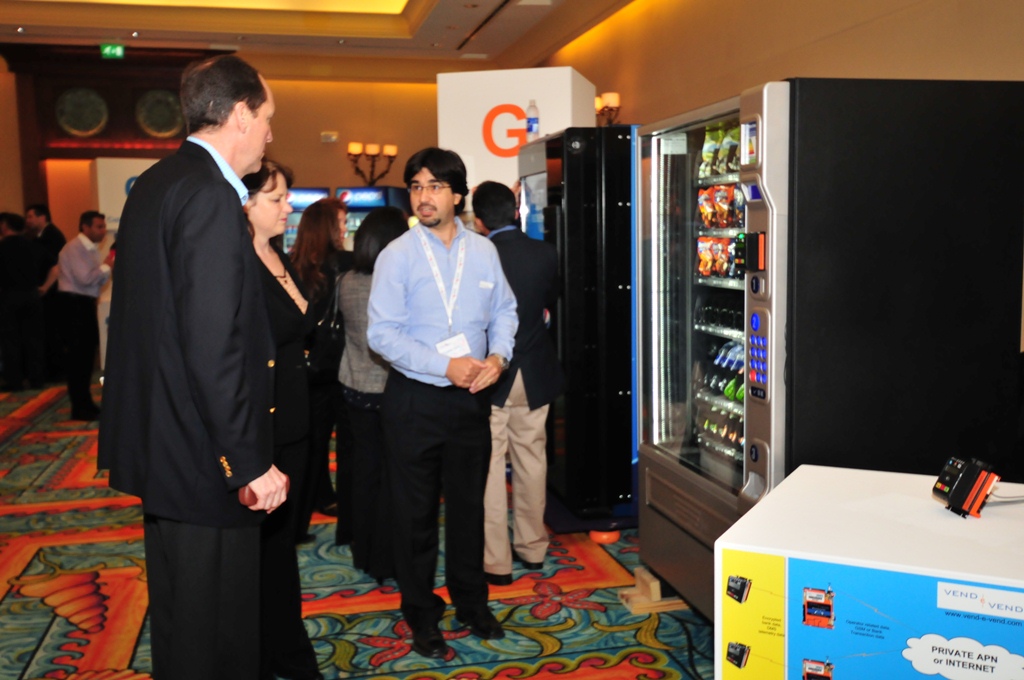
The same year we took our own stand at PepsiCo's global event in Dubai and presented the solution directly to global leadership. A month later a credit card pilot went live with PepsiCo at New Delhi Airport.

Source: Our own photo archive
-
2013
On the manufacturer's own shop window
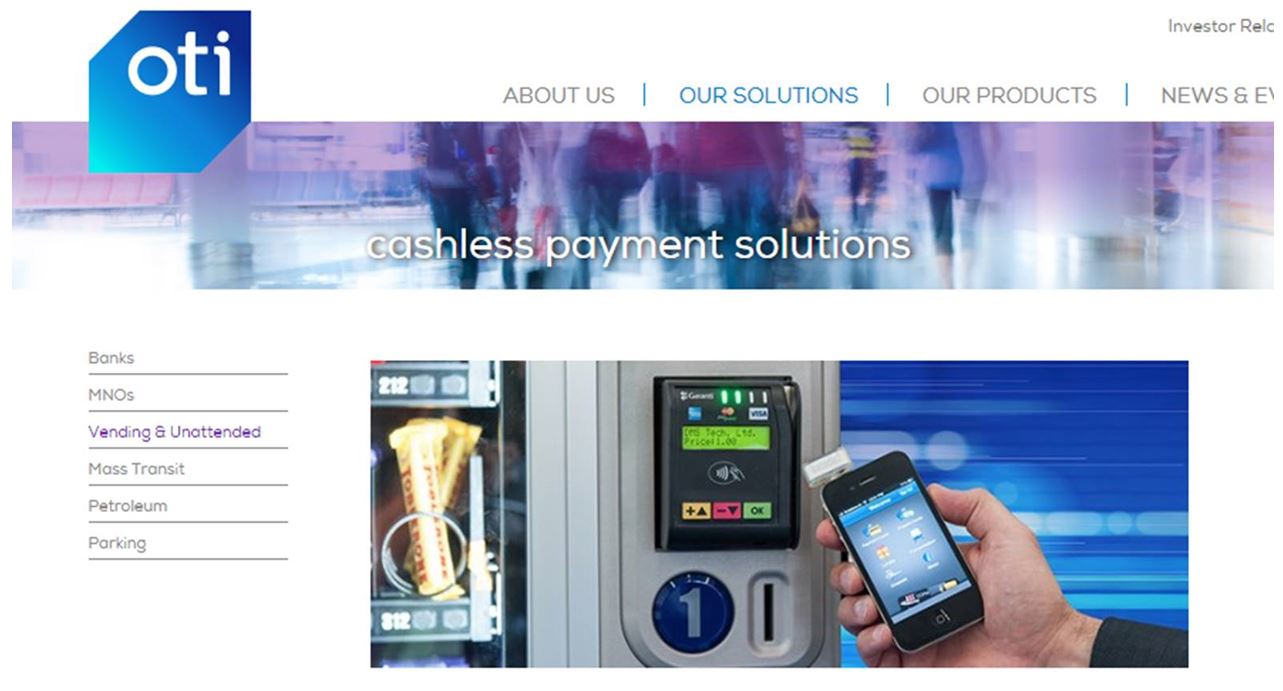
OTI's global "Vending & Unattended" solution page used a photograph of a vending terminal as its hero image. The text on that terminal's screen reads DMS Tech. Ltd. OTI took the picture themselves.

Source: OTI corporate site, "Vending & Unattended" page, 23 November 2013, archived OTI's archived page
-
2015
The rest of the world catches up on chip
Nothing happened here worth an entry. We include the year because of what happened elsewhere.
Source: U.S. Payments Forum
-
2017 – 2018
Meal cards
We developed acceptance of meal-benefit cards at the machine, working with the scheme's own project teams. The first scheme went live in 2018: Setcard.
Source: Our own record — the partner is not named, by agreement
-
2019 – 2020
Selling from machines against meal vouchers
The schemes came online one after another: Setcard in 2018, Multinet and Ticket/Edenred in 2019, Metropol in 2020. Four schemes in three years. Each one is a separate integration; the machine now accepts more than one card type.
Over the same period the payment started going cardless — on the Pluxee side the work moved to QR. The machine side of the meal voucher's journey, from paper to card to QR, was built in these three years.
Source: Our own record — the schemes are named as accepted payment methods, not as a statement of partnership
-
~2019
The transit card back in machines, on its new technology
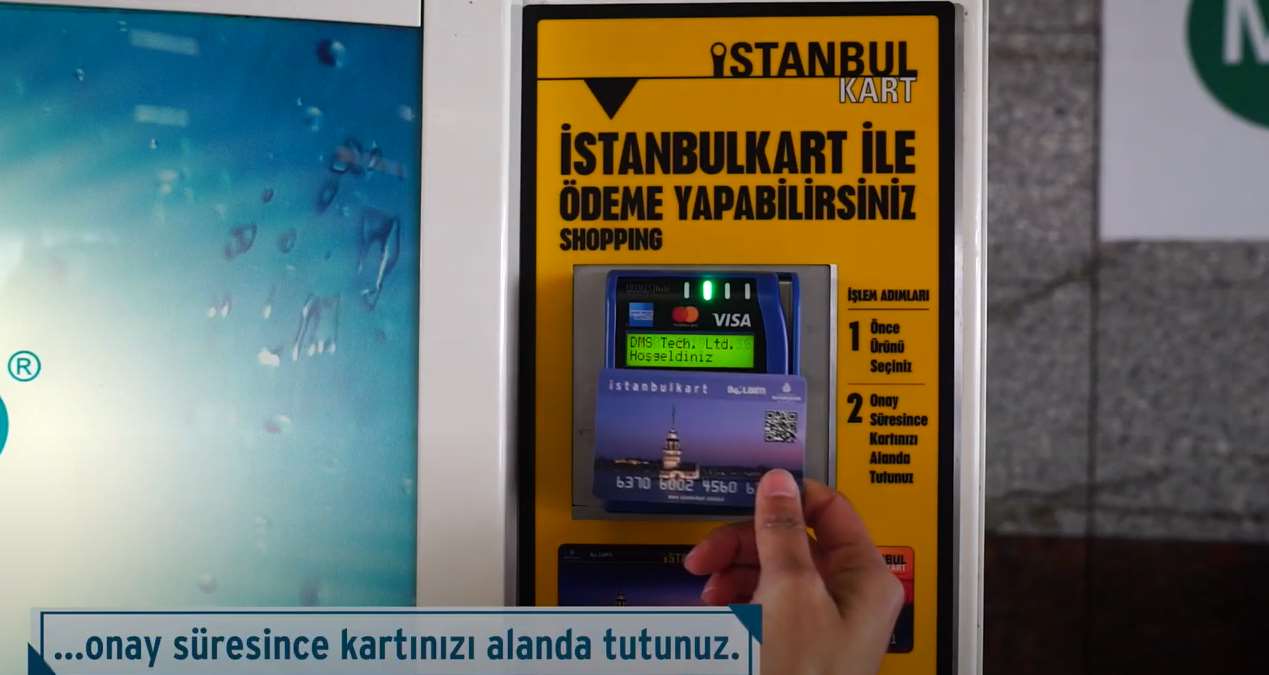
The city transit card is accepted at public water machines; the device screen reads DMS Tech. The same idea arriving a second time: in 2007 we were running Akbil top-up on a touchscreen machine, and that was a contact token. This time the card itself had changed — we did the same job on the transit card's new-generation technology.

Source: The transit operator's own promotional video the video
-
2020
Three separate directions
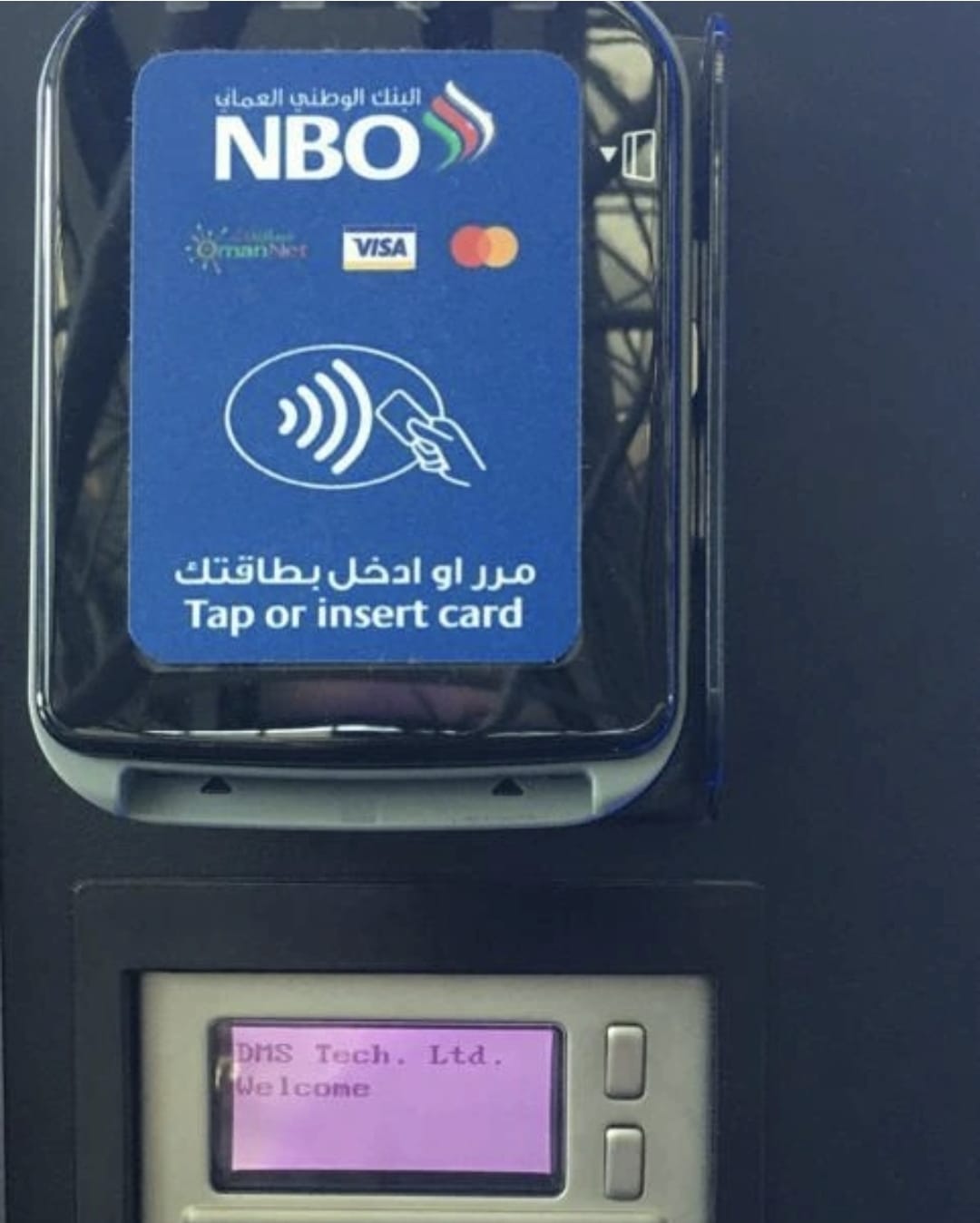
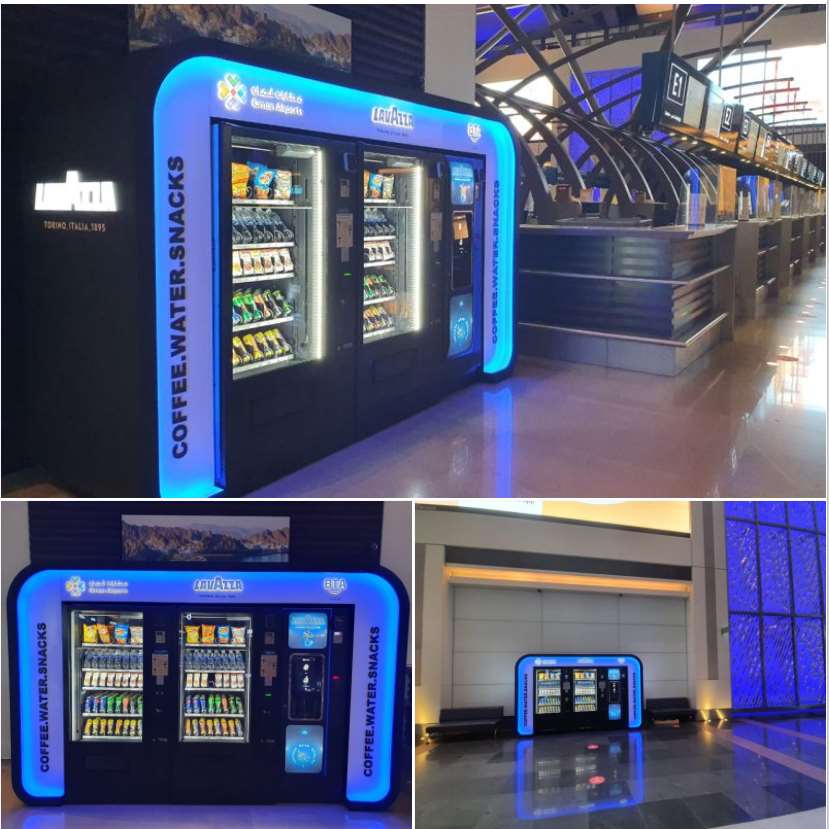
We moved to a cardless flow: the meal scheme now also works by QR. The Muscat Airport project went live — a third, separate protocol with Ingenico Oman, running over the national bank and the national payment network; the terminal's own screen again read DMS Tech. Ltd.
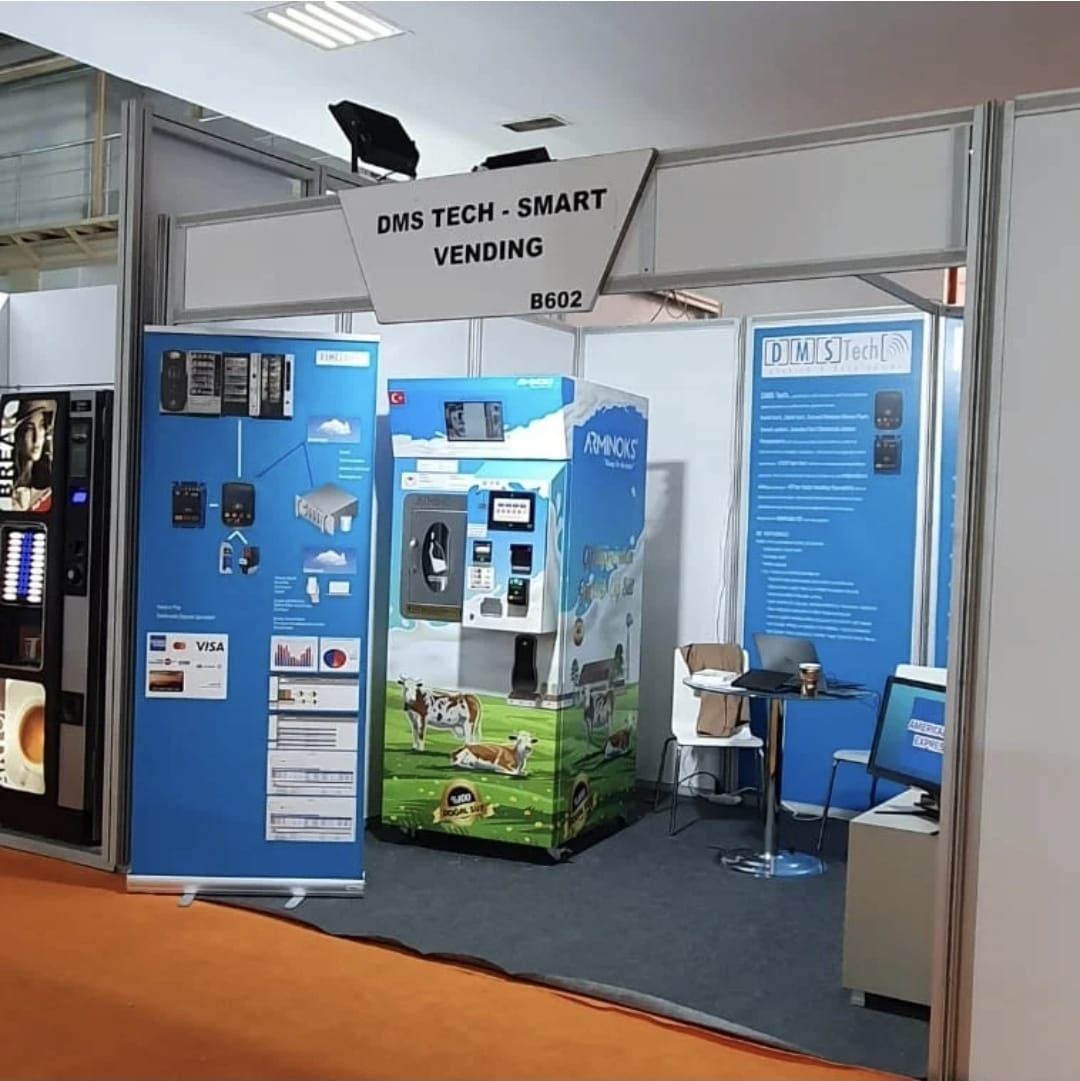
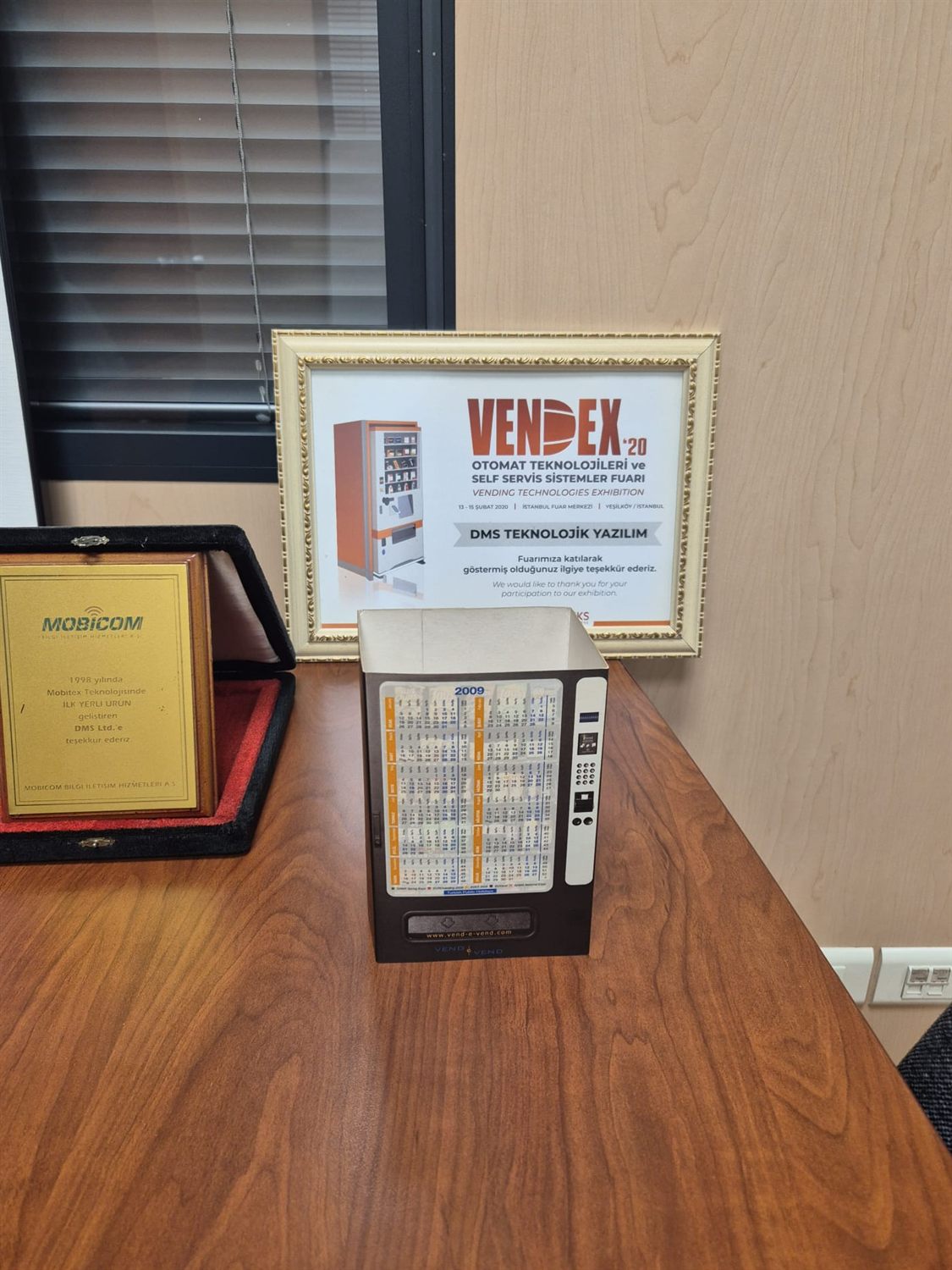
And the machine we exhibited on our own stand that year was not a vending machine at all: a milk dispenser driven by a PLC. No MDB, no Executive — industrial automation hardware.


Source: Our own field archive · trade fair participation record
-
2021
Running in Muscat
A year after go-live, the solution is working in the field at Muscat Airport: the payment layer on the coffee machines is ours, over the third of the three protocols.
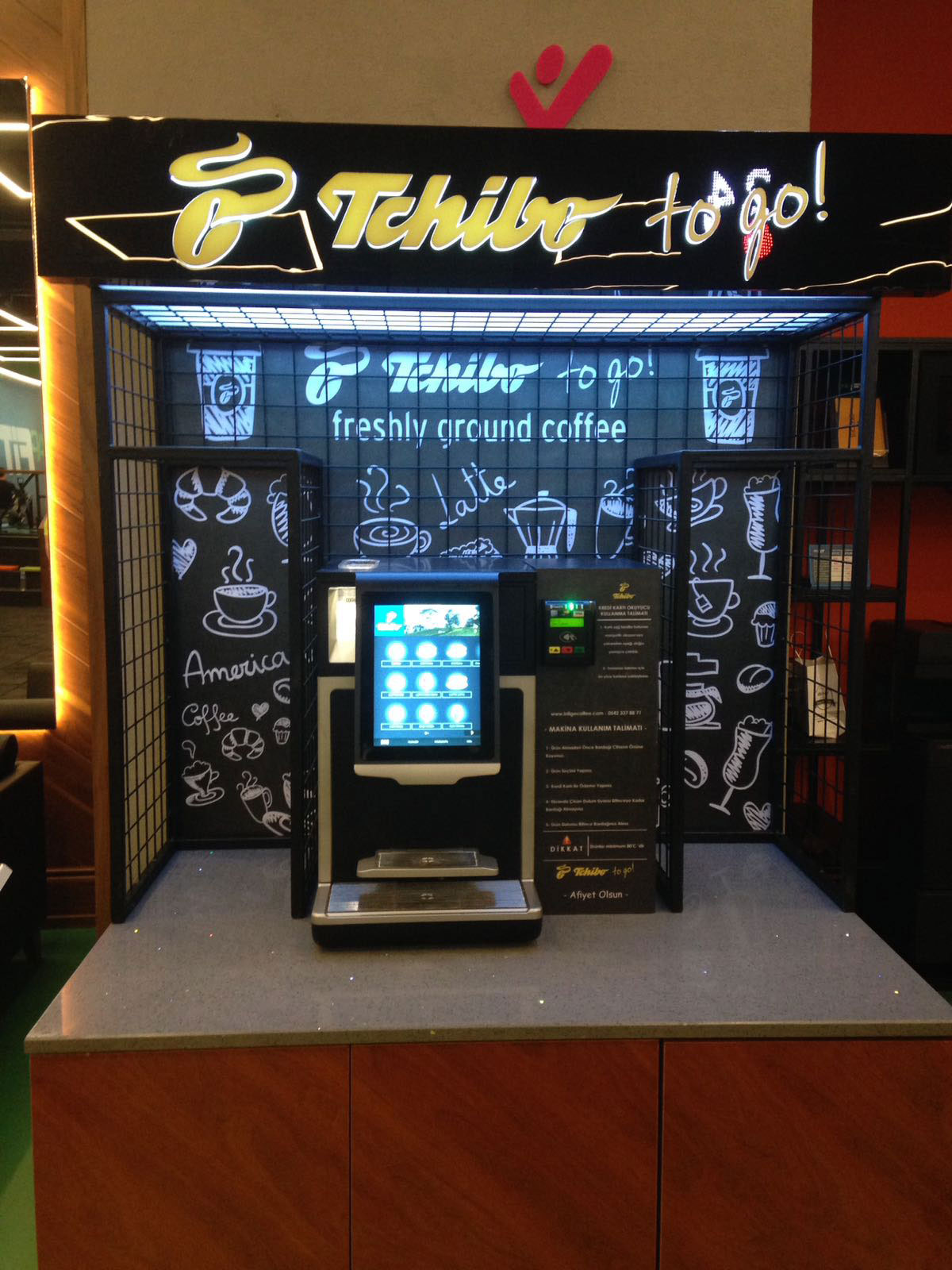
At home, the same layer is on Tchibo To Go's coffee machines — the distributor's own site describes the card solution on them as ours. Coffee is not a side vertical here: it is where a payment device meets the public most often.


Source: Our own archive · the distributor's own site (Tchibo To Go) the distributor's page
-
2025
A seventeen-year line closed, and the fleet changed again
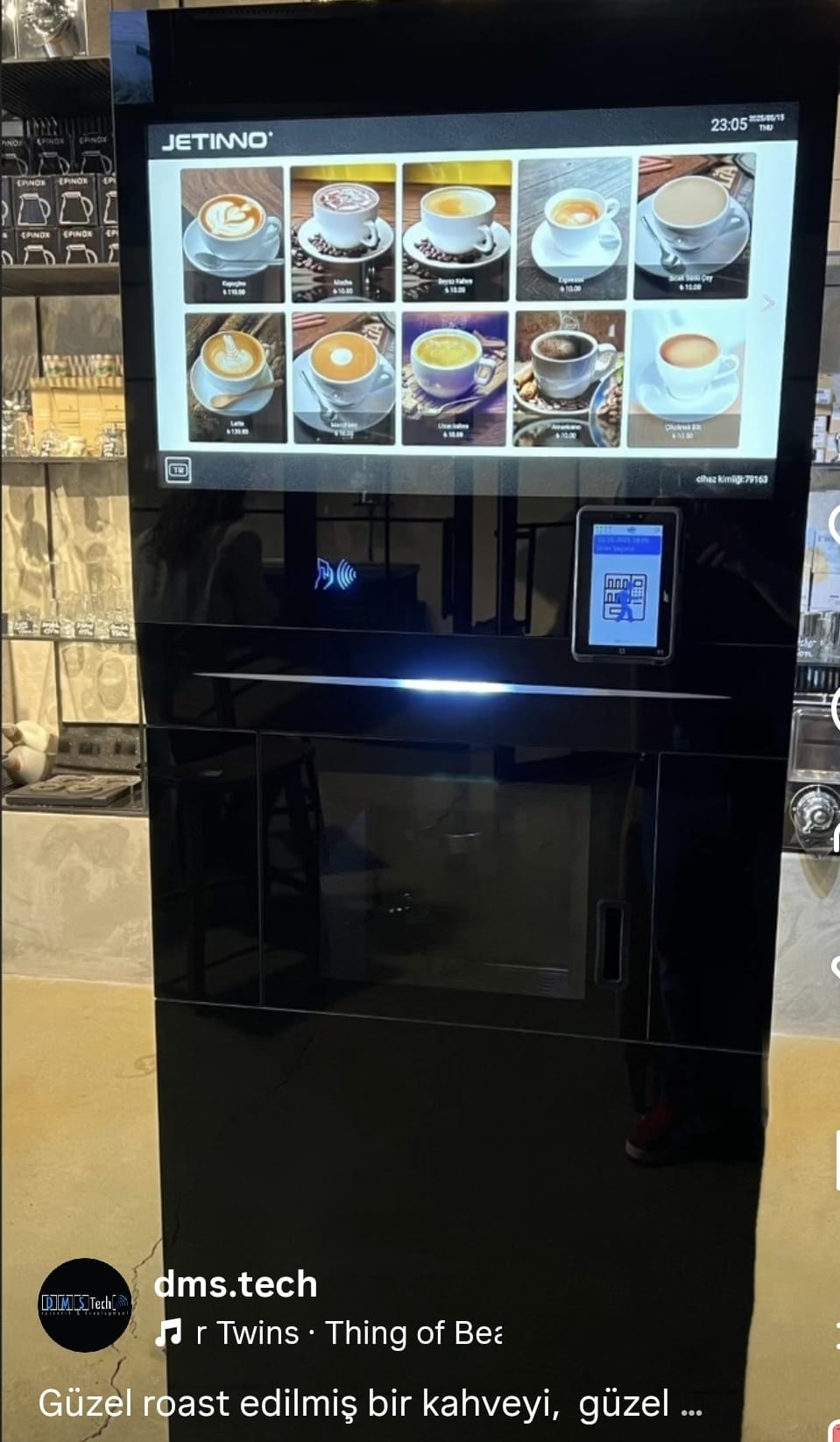
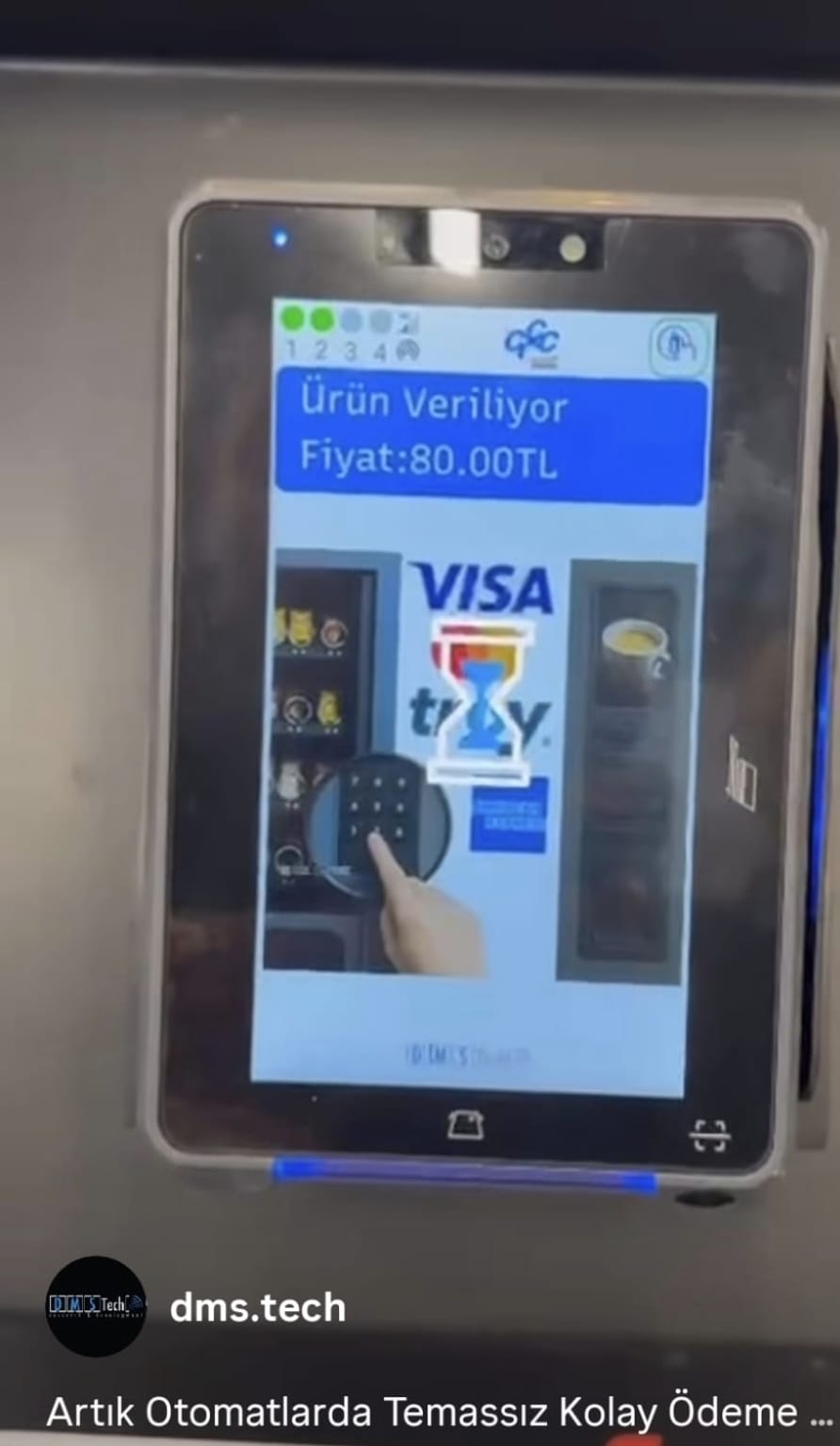
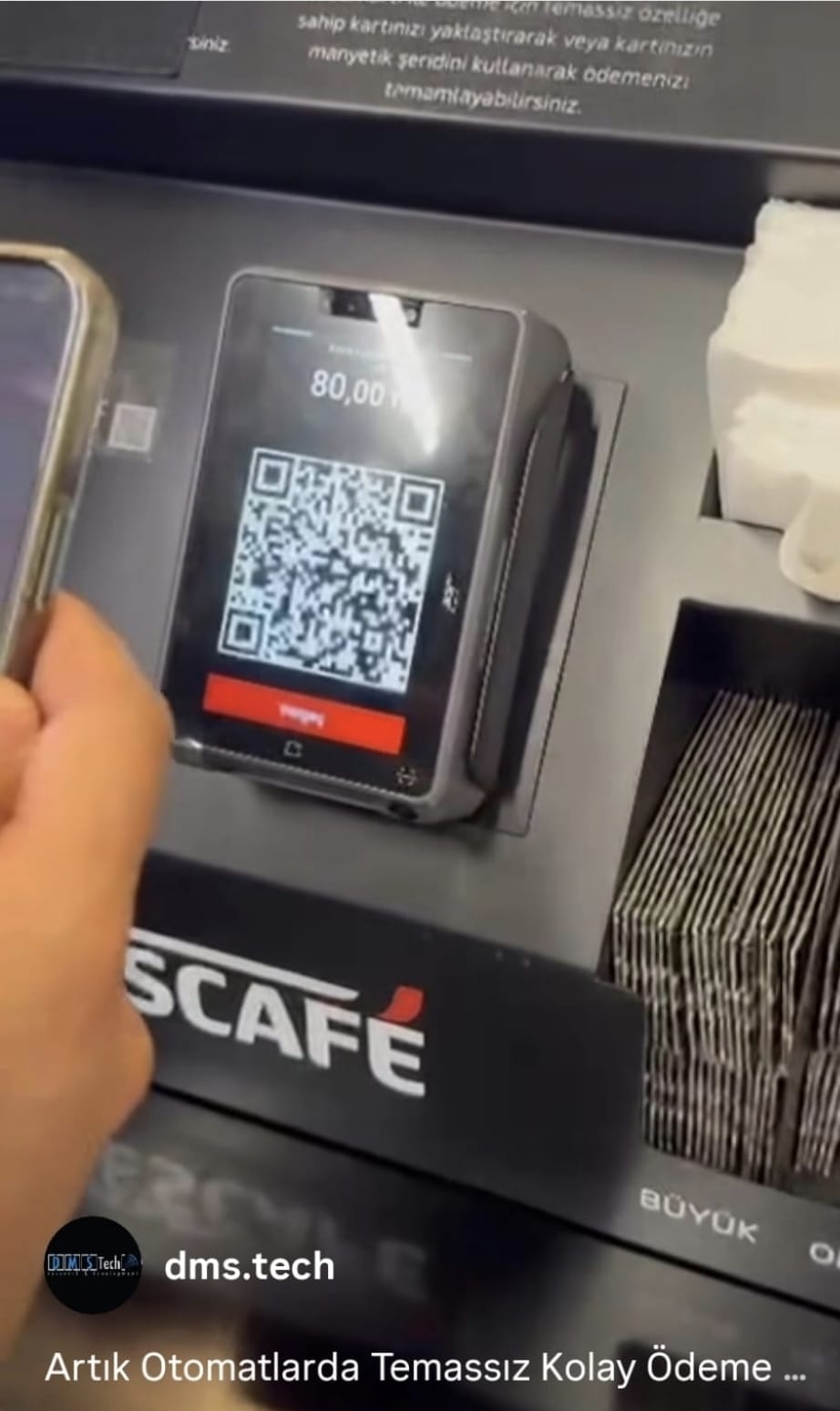
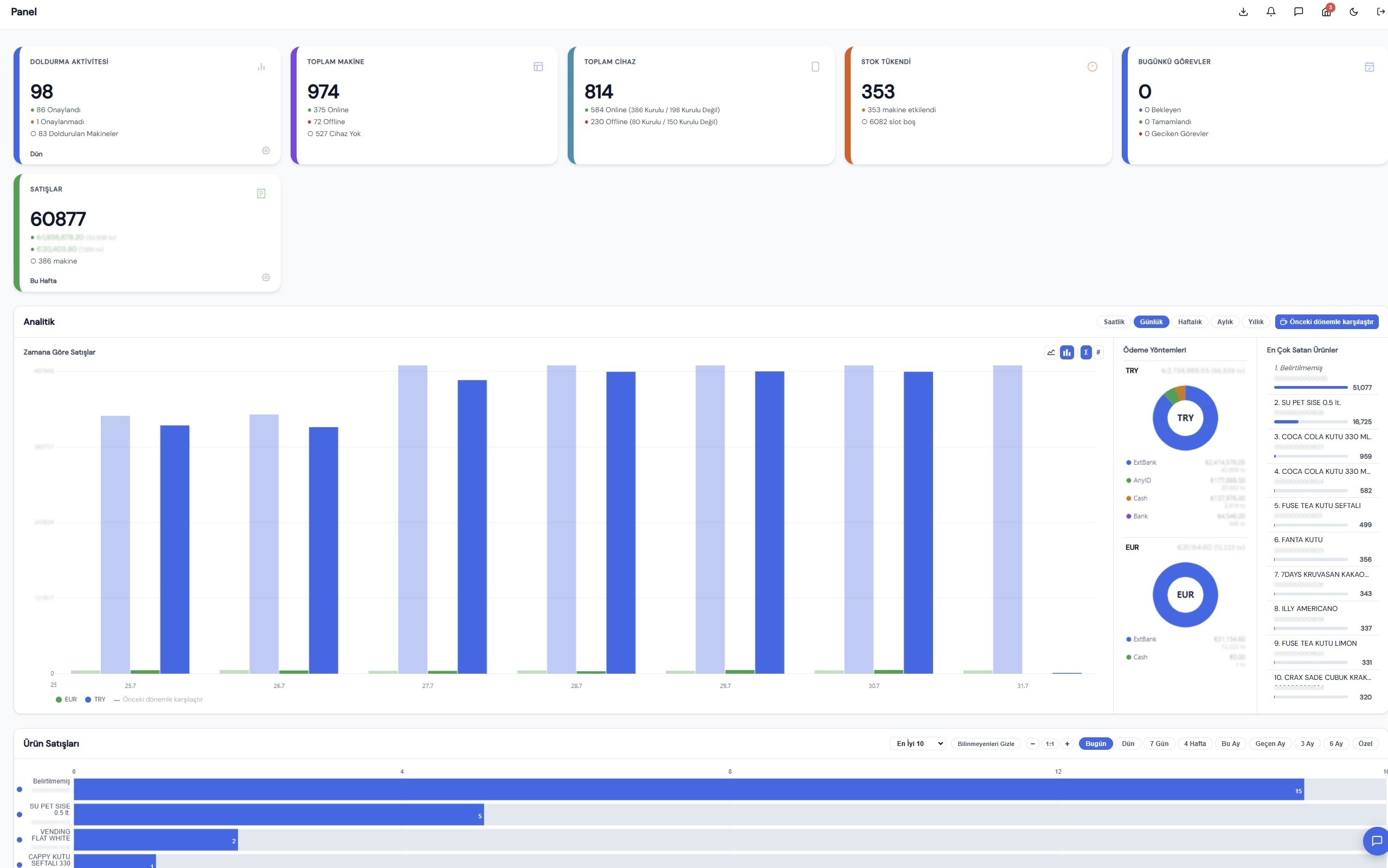
Android-based HERO software replaced the contactless line written in 2008. Over a seven-month field window the existing fleet was converted to Android — the counterpart, fifteen years on, of the 2008–2010 migration.
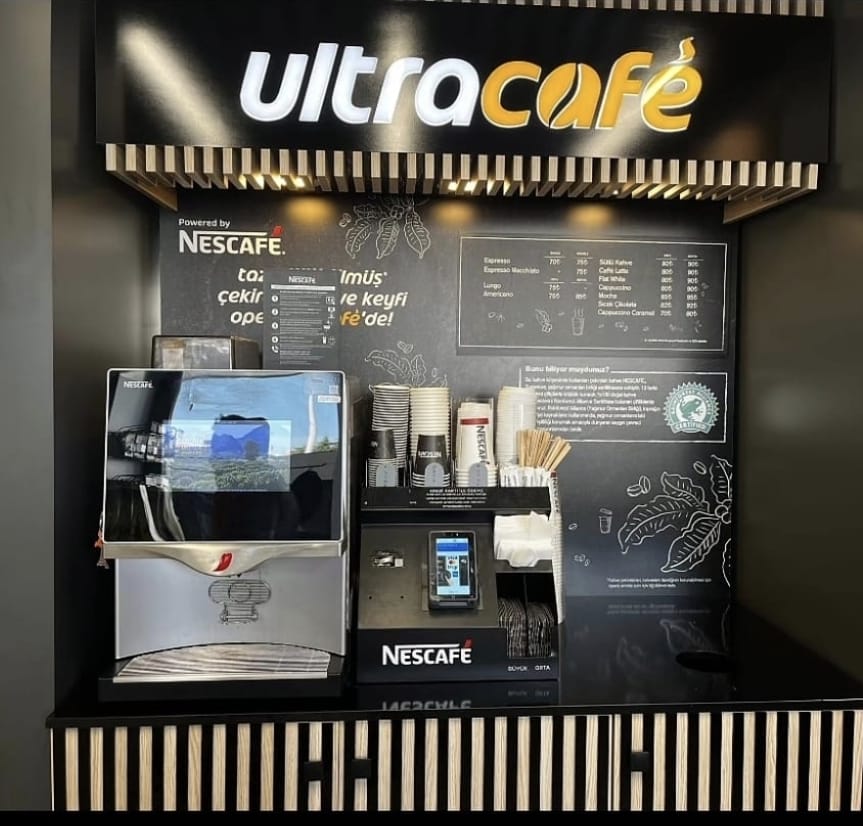
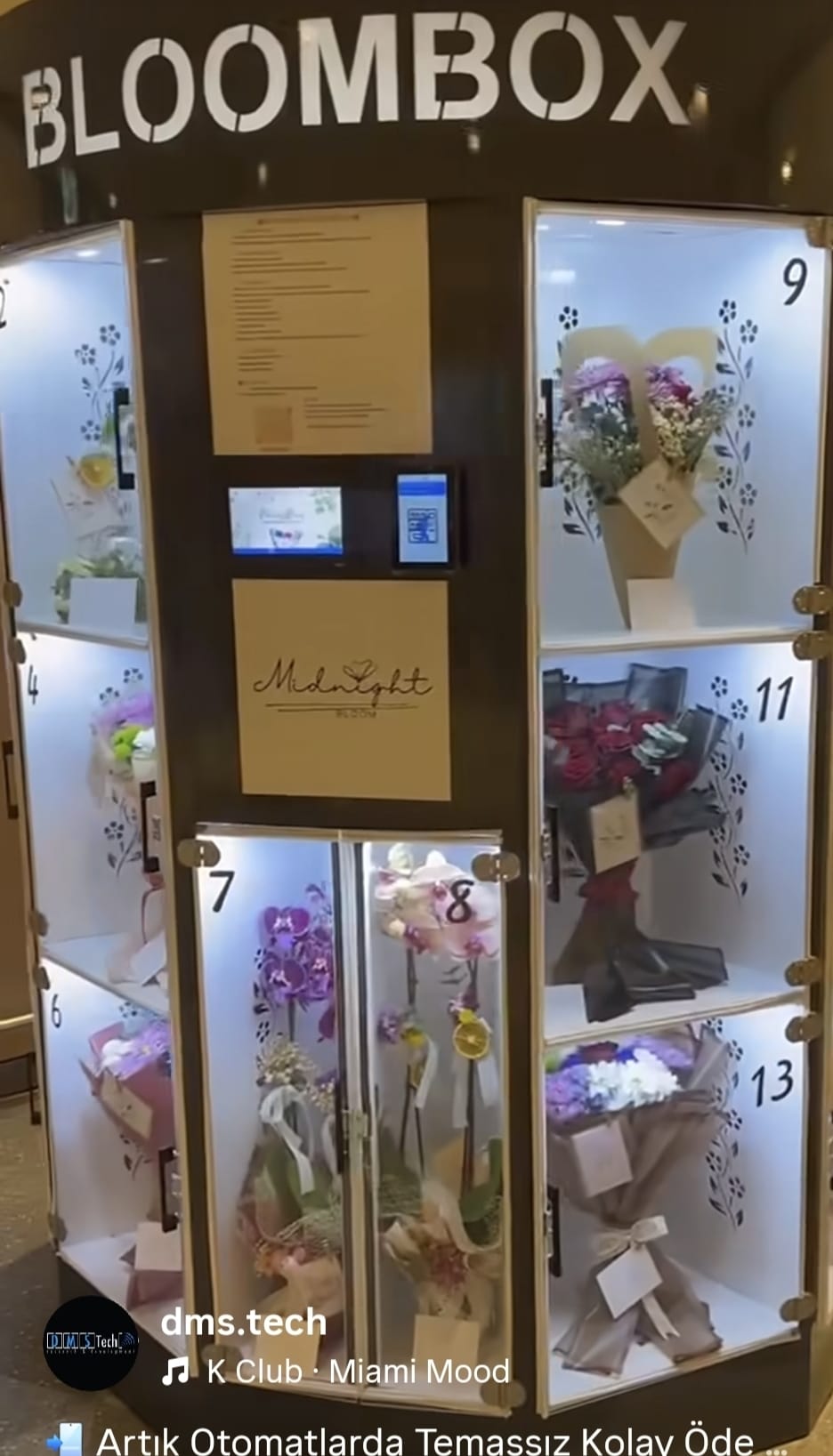
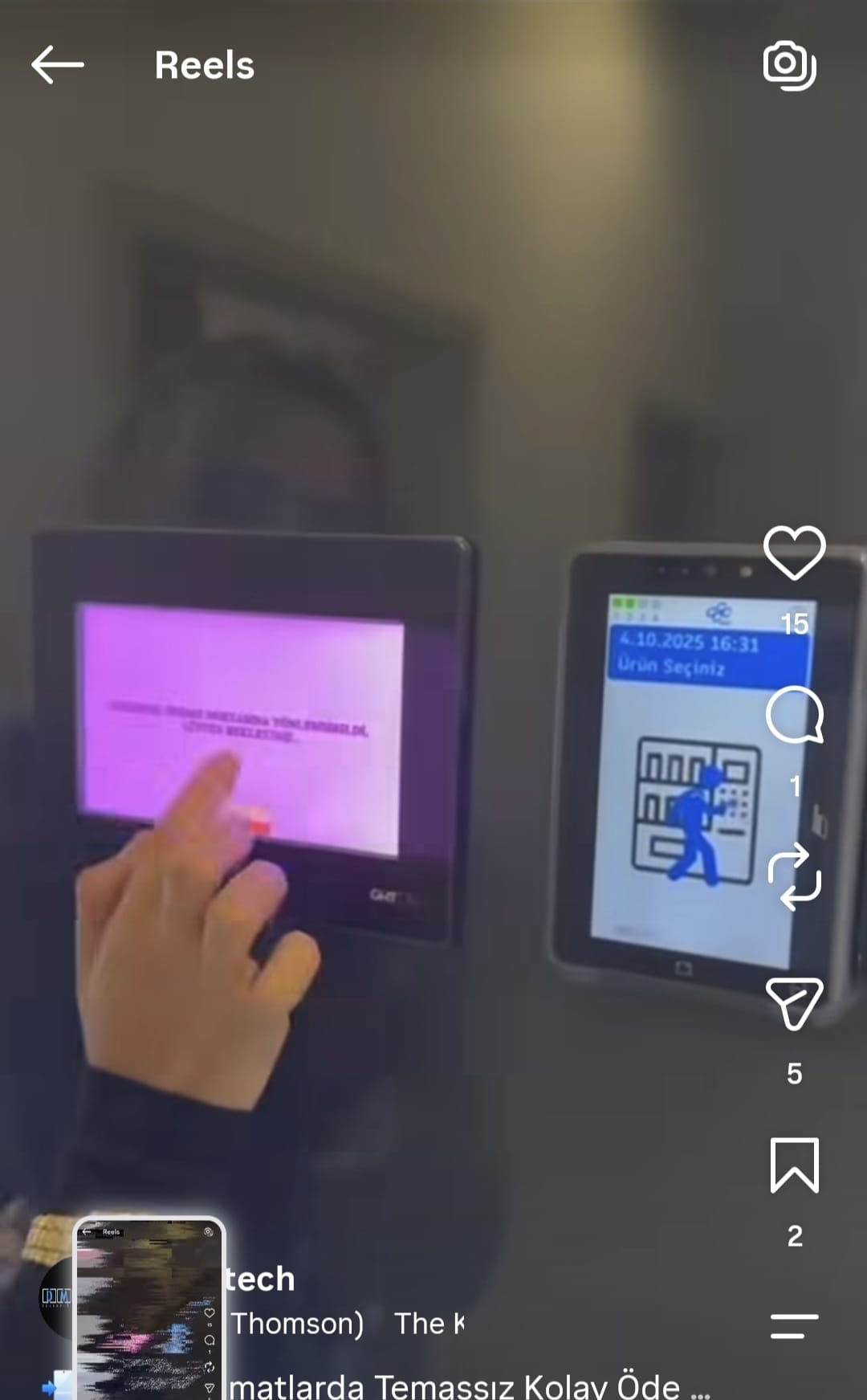
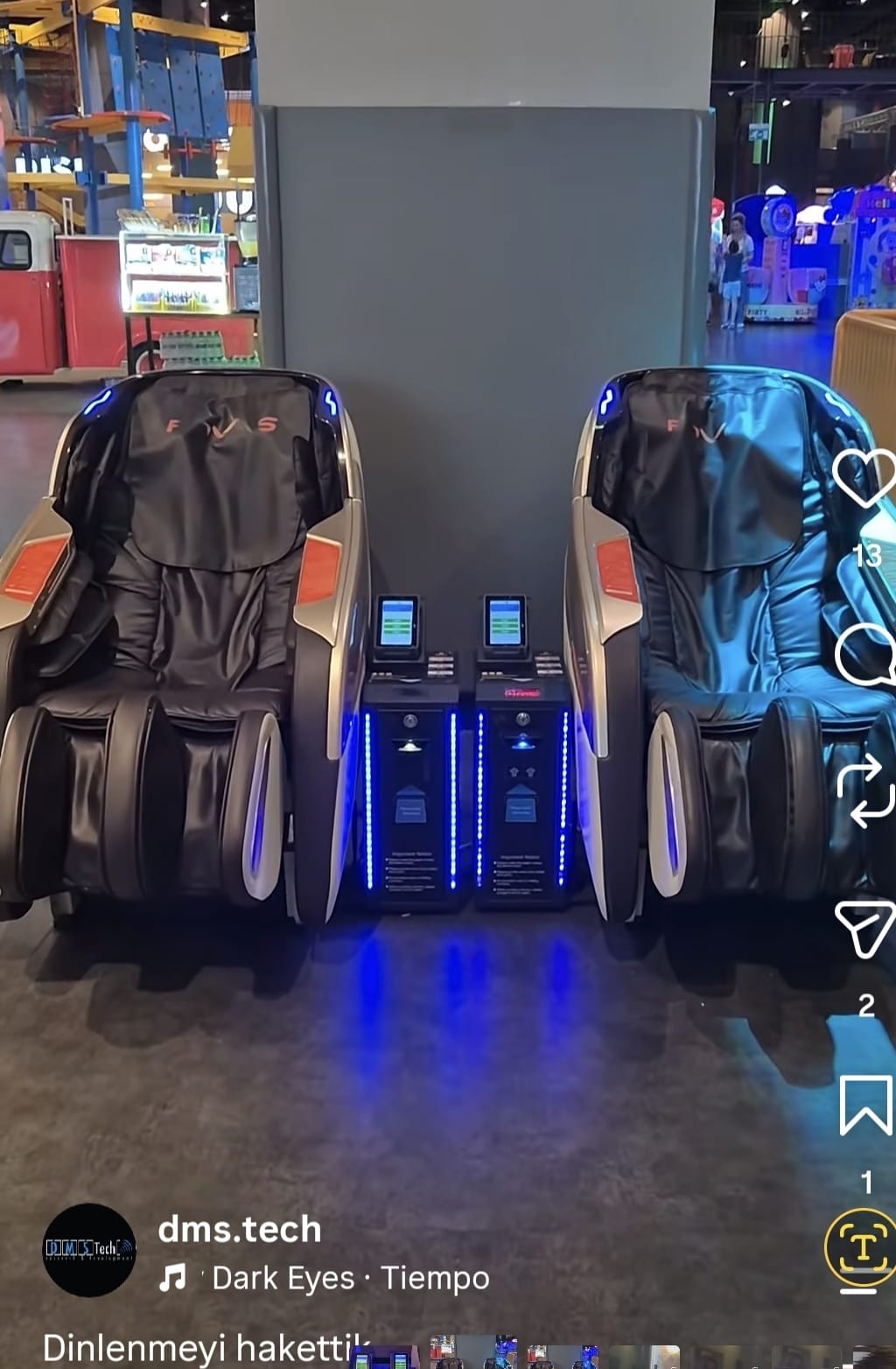
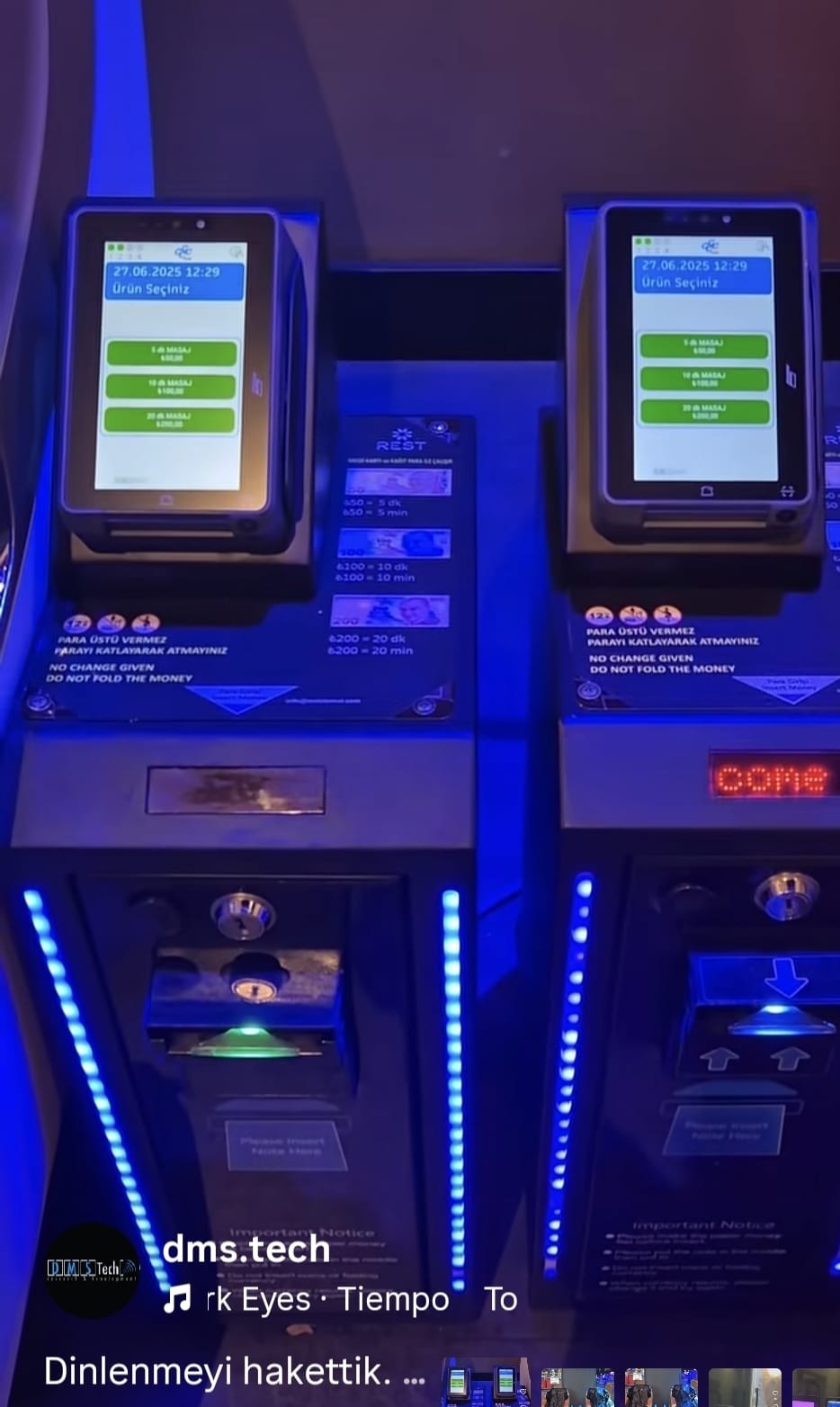
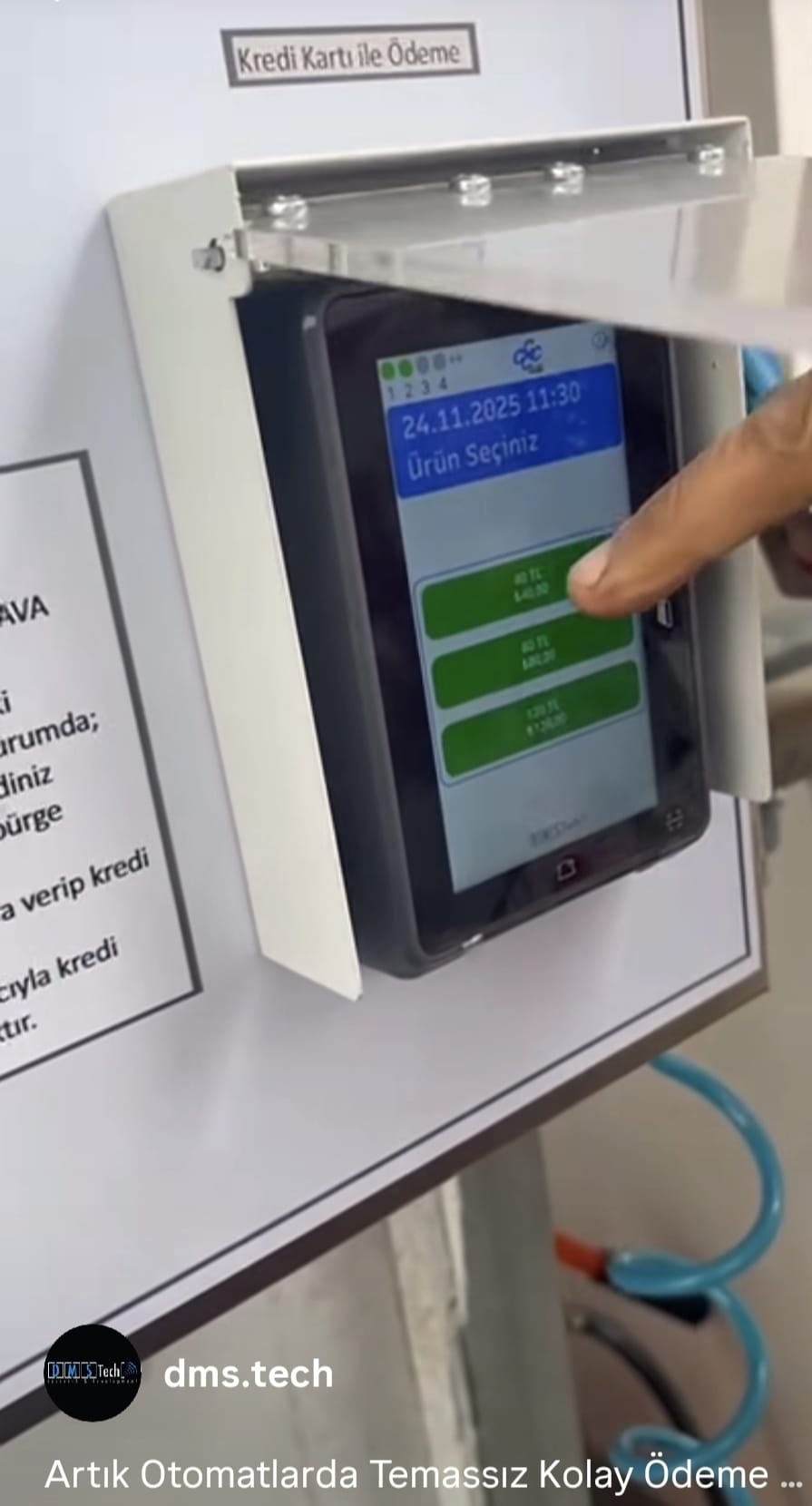
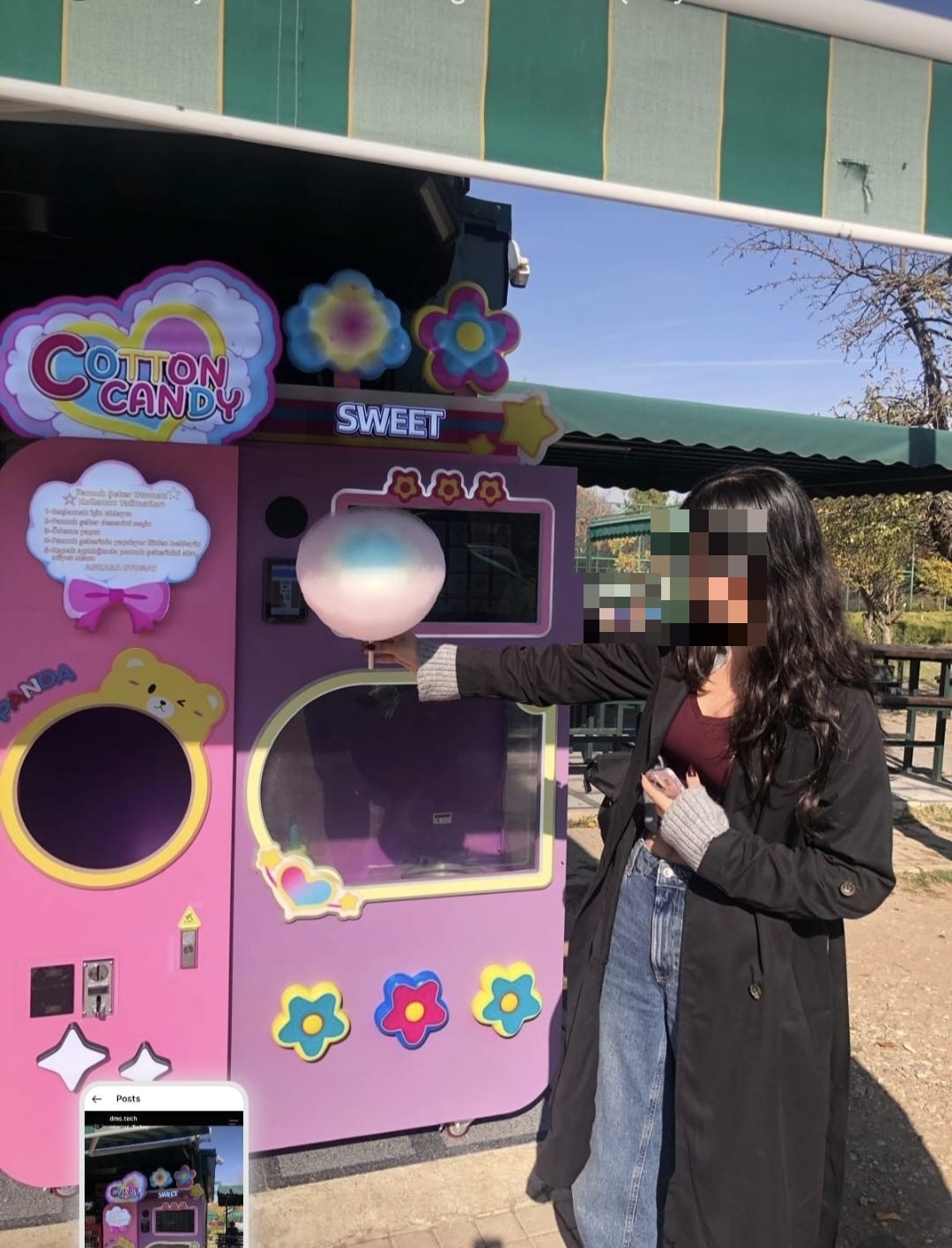
New verticals opened in the same window: coffee machines at fuel-station cafés with Nestlé Professional, a car wash and vacuum station, a massage chair, a flower machine, a candy floss machine in a car park. And an electromechanical Pepsi machine from the 1990s was connected to the new device.


Source: Our own field archive — the dates are readable on the machine screens
-
2026
Still going
HERO shipped and the edge device is in the field. The product isn't frozen; it grows by being updated.
We are still registered in the industry's data standard. In 2009 we were one of three companies from Turkey on that list; today there are eight, and we are still on it.

Source: EVA DTS manufacturer code registry the current list

The architecture
It was right from the start
In 2002 we described ourselves as building protocol converters and gateways. Since then the same thing has happened every time.
We defined the serial protocol between the payment terminal and our board, and the manufacturer on the other side wrote their application to our definition.
This is not something that happened once. Three separate protocols, two manufacturers, three countries:
| When | Who | What |
|---|---|---|
| 2008 → 2025 · moving to a new acquiring bank | OTI | The first contactless product in front of our controller. We wrote the protocol; OTI added it to their own reader firmware. |
| June 2008 · card industry fair | Ingenico | A separate protocol — unrelated to the first. |
| June 2020 · Oman | Ingenico Oman | A third, different protocol again, over the national bank and payment network. |
The visible proof sits in two photographs: in 2013 on the screen of OTI's reader, and in 2020 on the screen of an Ingenico terminal, the text reads DMS Tech. Ltd. Two countries, two manufacturers, two banks — our name on the manufacturer's own device. That is not a sticker; it is what driver-level integration looks like from the outside.
And it still works this way. In 2025 we connected to a PLC-driven machine over Modbus. Modbus is a transport standard; it does not define what the registers mean. What defines them is our flow, and the machine manufacturer conforms to it. The same thing OTI and Ingenico did in 2008 — except this time the other side is a machine builder.
Responsibility
Unchanged for a quarter century
Who holds the card data, and who carries it.
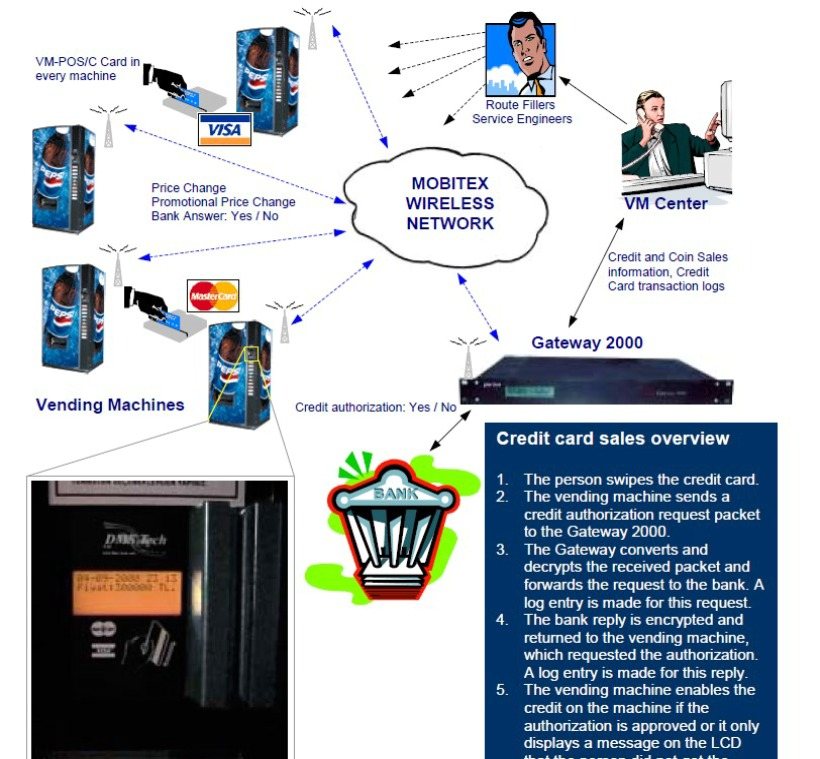
A certified EMV reader encrypts the card data. We built and operate the protocol and the central system that carry that encrypted data to the bank.
You can read this architecture, word for word, in our own 2001 product brochure:
The data sent by the vending machines is encrypted, so the gateway takes care of decrypting this data and then decides if this data was statistical information or credit card information … it creates a bank data packet, which is sent to the bank to get authorization … The authorization information returned by the bank is then encrypted and returned to the correct vending machine.
Encrypt at the edge → decrypt at the centre → separate statistics from card traffic → authorise with the bank → encrypt the answer back to the machine. Twenty-five years, the same five steps.
Hardware independence
A list, not a claim
Our controller has run in the field on these machine brands.
- Bianchi
- Crane
- De Jong Duke
- Coffetek
- Dixie Narco
- FAS
- Flymax
- Franke
- Fuji
- Gerhardt
- GPE
- Jofemar
- Laser
- Lavazza
- Magma
- Necta
- OranFresh
- Rhea Vendors
- Royal Vendors
- Sanden Vendo
- Sielaff
- Saeco
- TCN
- Unicum
- VCM
- Wurlitzer
- Wittern
Twenty-seven manufacturers. But the number of brands is not the point — which layer we connect at is:
| Machine | Its protocol | How we connect |
|---|---|---|
| 1990s electromechanical machines | none | relay + voltage sensing |
| MDB machines | MDB | MDB |
| PLC milk dispenser (2020) | PLC | our own serial protocol |
| Massage chair (2025) | none | dry contact / relay |
| Flower machine (2025) | PLC | Modbus transport, our flow |
| Car wash station (2025) | PLC | dry contact — the customer's preference |
The last two are from the same year, weeks apart: both PLC machines, one over Modbus, one over dry contact. The choice comes from what the job needs, not from a technical limit.
The claim isn't "we can connect to any machine." It's one step past that: we connect at whichever layer you want.
A working demonstration
Three generations, one frame
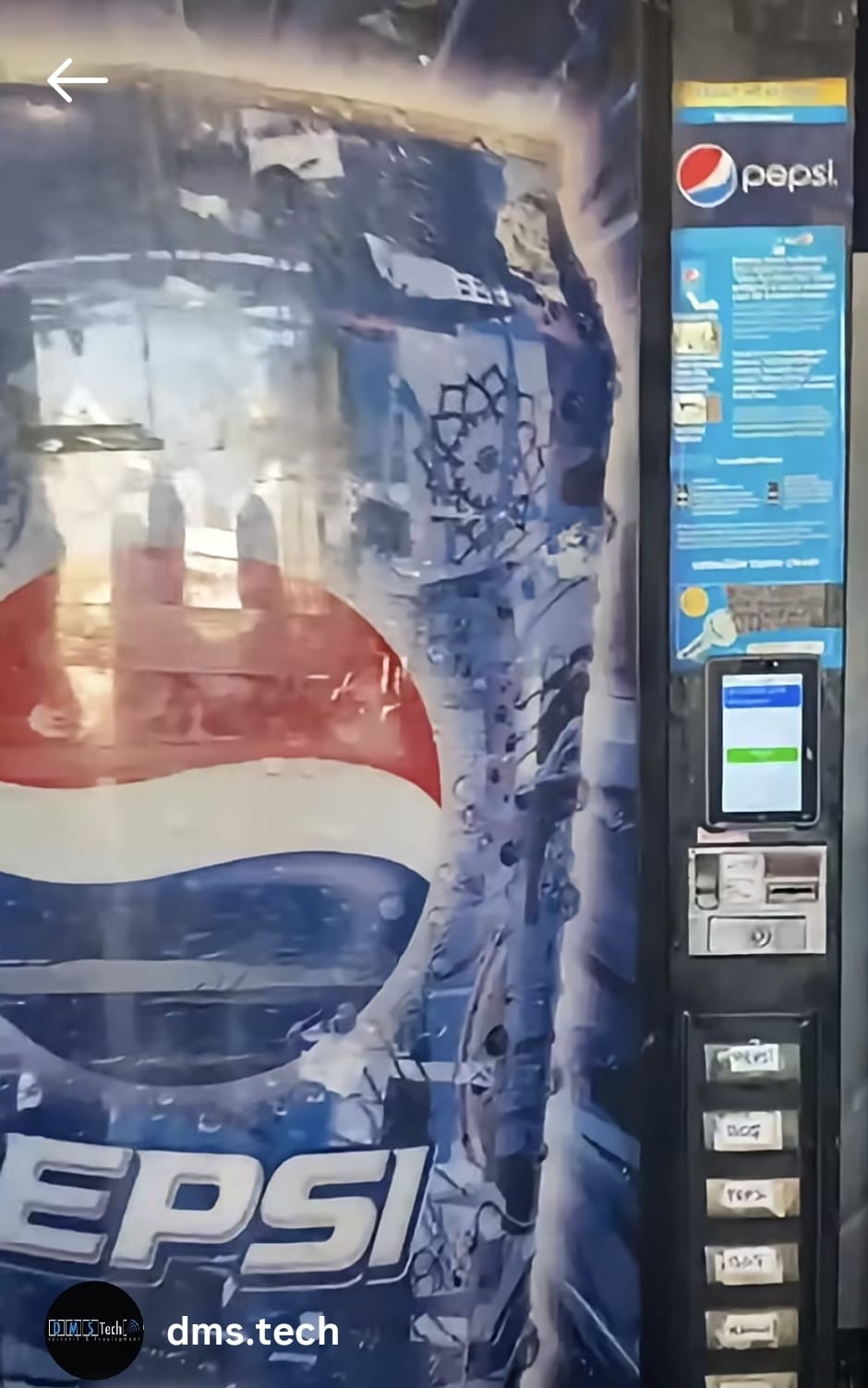
An electromechanical machine from the 1990s, running today.
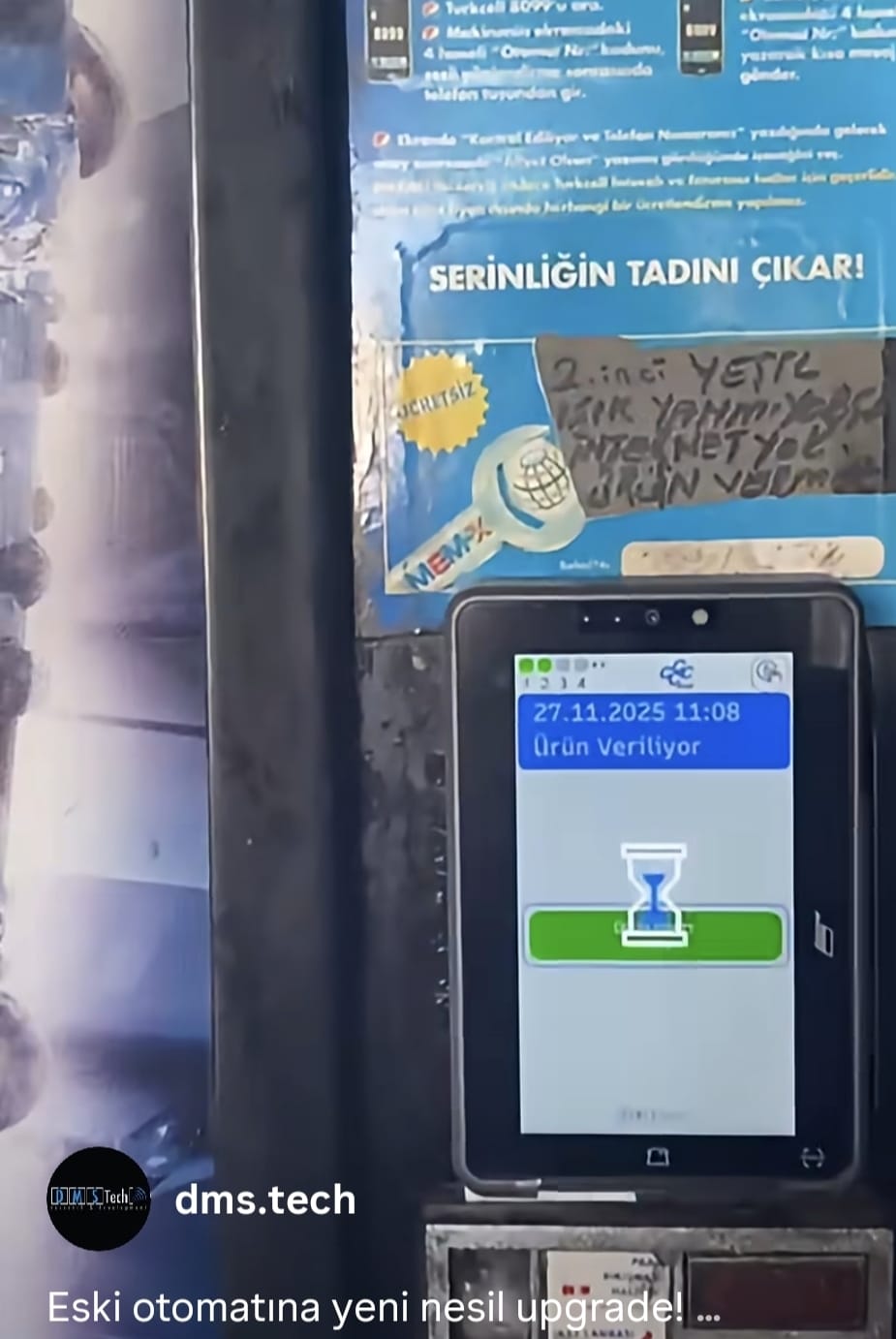
A Dixie Narco machine from the 1990s — no protocol, relay and voltage only — is running today on an Android device. The bridge between them is the descendant of the method in our 2001 brochure.
There are three generations in that one frame: the 1990s machine, a 2003 poster still hung above it advertising purchase-by-phone, and the 2025 Android device. All three are ours, and all three work.
Method
How this page was written
Behind every entry there is either a printed publication from the period, a partner's own material, or a field record with a readable date.
Where the source is our own archive, we say so. Three things we deliberately did not do:
We made no exclusivity claim in our own voice.
"First in Turkey" appears on this page more than once, and never as our sentence. Each time it is a quotation — Pepsi's launch leaflet, Kanal D Home Video's own news page — and each time it is the customer claiming something about their own product. We report what they wrote; we do not adopt it.
We didn't delete the ones we lost.
In 2007 we put a DVD rental machine into the field; that same year streaming began to take hold. Being early is not the same as winning, and this page shows that too.
We didn't write uncertainty as certainty.
Some dates are given as a range, because the document we hold shows a range. We would rather leave a range than make an unsure date look sure.
It will keep developing with new needs, requests and expectations — as it has, and as it will.
No advertising. Engineering.
Last updated: 2 August 2026
Twenty-five years of this is available to your fleet.
Tell us what your machines are and how they connect. We will tell you what it takes.